
Independent field guide · Compare
Ultherapy vs 10Therma vs Rejuran: lifting vs RF vs injectable
Ultherapy is focused ultrasound for lift. 10Therma (텐써마) is Korean monopolar RF, same family as Thermage. Rejuran is a skin-quality injectable, not a lifting device.
8 min read · By Glow in Seoul editorial · Updated August 27, 2026
Start with the essentials
Short answer to the comparison people actually type. Ultherapy is focused ultrasound (HIFU) for deeper lifting. 10Therma (텐써마) is a Korean monopolar radiofrequency device for broader tightening — the same energy family as Thermage, a different machine. Rejuran is a polynucleotide injectable for skin quality, not a lifting device. They are different jobs, and clinics often combine an energy session with an injectable rather than ranking them.

The other pairing people search: Juvelook vs exosome. These are not two versions of one thing. Juvelook is a PDLLA collagen biostimulator — microspheres injected into the skin that your body breaks down over months while producing its own collagen, so the change is structural and gradual. Exosome products in Korea are usually an add-on applied to the skin straight after a laser or microneedling session, discussed for recovery and skin condition rather than months of firmness; ask any clinic what the product actually contains and how it is applied.
For the energy-device question in more depth, our Ultherapy vs Thermage guide covers how ultrasound and radiofrequency differ, including where 10Therma sits next to Thermage. For generic HIFU devices against Ultherapy, see our HIFU vs Ultherapy comparison.
Below, each pairing gets a decision table: what it is, which mechanism category it belongs to, typical downtime, typical sessions, how long the result is discussed as lasting, and the one question worth asking the clinic. Everything here is directional and neutral — suitability, the plan, and the price are confirmed by a clinic, not by us.
Section 01
Ultherapy vs 10Therma vs Rejuran: three different jobs
This is the three-way comparison people type. They are not three versions of one treatment. Ultherapy is focused ultrasound (HIFU) aimed at deeper lifting. 10Therma (텐써마) is a Korean monopolar radiofrequency device aimed at broader tightening — the same energy family as Thermage, a different machine. Rejuran is a polynucleotide injectable for skin quality, not a lifting device at all.
Clinics often plan an energy treatment and a skin-quality injectable together rather than instead of each other. Which combination suits you is a doctor's call after looking at your skin, not something a menu ranking can answer. The Ultherapy vs Thermage guide covers the energy side in more depth, including the distinct device names and quote units for Ultherapy, Thermage and 10Therma.
| Treatment | What it is | Job | Typical downtime | What to ask |
|---|---|---|---|---|
| Ultherapy (울쎄라) | Branded focused ultrasound (HIFU), with imaging of the layer being treated | Deeper structural lift | Low — redness or tenderness for hours to a day | Genuine branded device, line count, which areas the quote covers |
| 10Therma (텐써마) | Korean monopolar radiofrequency; same energy family as Thermage, a different device | Broader tightening and collagen heating | Low — mild redness possible for a day | Which device by name (10Therma vs Thermage vs Oligio), tip or pass count |
| Rejuran (리쥬란) | Polynucleotide (PDRN/PN) injectable — not an energy device | Skin quality, repair, hydration of the skin itself | Minimal — small bumps or bruising 1–2 days | Which product in the family, how many vials, how it sits alongside any energy session |
Directional and neutral — not a ranking and not medical advice. Energy lifting builds over weeks to months; a clinic confirms what suits your skin and the price.
Section 02
Juvelook vs exosome vs Rejuran: three injectable-adjacent categories
These three names get compared constantly because they all show up on a Korean menu under "skin quality" and none of them is a filler. They sit in genuinely different categories, though: Juvelook is a biostimulator that works by prompting your own collagen, Rejuran is a polynucleotide injectable discussed for repair and resilience, and an exosome product is a signalling add-on that is usually paired with a laser or microneedling session rather than sold as a stand-alone structural treatment.
One regulatory point worth carrying into the consultation: in Korea, exosome products are commonly applied to the skin after a procedure rather than injected as a licensed injectable drug, and what is inside them varies a lot between products. That is not a reason to avoid them — it is a reason to ask the specific question in the last column below. Our collagen stimulator guide goes deeper on the Juvelook side and the Rejuran guide on the PDRN side.
| Treatment | What it is | Mechanism category | Typical downtime | Typical sessions | How long it's discussed as lasting | What to ask the clinic |
|---|---|---|---|---|---|---|
| Juvelook (PDLLA) | Poly-D,L-lactic acid microspheres suspended in a hyaluronic-acid carrier gel | Collagen biostimulator — prompts your own collagen | Minimal — swelling, small bumps or bruising at injection points, usually settling within a few days to about a week | Commonly 2–3, roughly 4–6 weeks apart | Builds over months; commonly discussed as outlasting filler, though this varies by person | Which product and dilution, how many vials per session, and the specific massage and aftercare schedule for that product |
| Exosome treatment | Vesicle-based products, in Korea most often applied to the skin straight after a laser or microneedling session as an add-on | Signalling / recovery support — not a structural collagen stimulator | Minimal on its own; in practice you get the downtime of the laser or needling it is paired with | Usually bought per session as an add-on, sometimes a short series | Discussed in terms of the recovery and skin-condition window after a session, not months of structural change | What the product actually contains, whether it is applied topically or injected, and what its regulatory status is |
| Rejuran-type (PDRN / PN, "salmon DNA") | Polynucleotides purified from salmon, micro-injected into the skin | Skin-quality injectable — repair and resilience signalling | Minimal — possible small bumps or bruising for a day or two | Often 3–4, ~2–4 weeks apart | Course-based, then periodic maintenance | Which product in the Rejuran family, how many vials, and how many sessions fit your dates |
Directional, neutral descriptions — not medical advice, not a recommendation, and not a claim that any of these produces a specific result. A clinic confirms what suits your skin and which product it actually uses.
Section 03
Energy lifting vs skin-quality injectables: comparing jobs, not devices
This is the comparison that trips people up, because the device names sit on different axes. "HIFU" is an energy type, Ultherapy is one branded HIFU device, Thermage is a radiofrequency device, and Rejuran is an injectable. Sorting them into the right category first makes the choice much easier: if you want lift and tightening, you are choosing between ultrasound and radiofrequency; if you want skin quality, you are looking at injectables, and the two are often done in the same treatment plan rather than instead of each other.
Our Ultherapy vs Thermage guide covers how ultrasound and radiofrequency differ. For the question of generic HIFU devices versus branded Ultherapy specifically, see our HIFU vs Ultherapy comparison.
| Treatment | What it is | Mechanism category | Typical downtime | Typical sessions | How long it's discussed as lasting | What to ask the clinic |
|---|---|---|---|---|---|---|
| HIFU, generic (Shurink / 슈링크 and other domestic devices) | Focused-ultrasound devices that deliver heat in lines of points at set depths | Energy lifting — ultrasound | Low — possible redness or tenderness for a few hours to a day | Often repeated periodically; shot or line count varies by face and area | Builds over roughly 2–3 months as collagen remodels | Which device by name, how many shots or lines, and at which depths |
| Ultherapy | The branded original focused-ultrasound platform, with imaging that lets the operator see the layer being treated | Energy lifting — ultrasound | Low — possible redness or tenderness for a few hours to a day | Shot count customised to your face; some people repeat periodically | Builds over roughly 2–3 months; commonly discussed as holding for around a year or more, varying by person | Whether it is the branded device, how many lines, and whether the price covers the areas you want |
| Thermage | Monopolar radiofrequency — a tip heats a broader area of skin with each pass | Energy lifting — radiofrequency | Low — mild redness or swelling possible for a day or so | Often a single full session per area, sometimes repeated after a year or more | Builds over roughly 2–6 months | Tip size, number of passes or shots, and which generation of tip |
| 10Therma (텐써마) | Korean monopolar radiofrequency; same energy family as Thermage, a different device | Energy lifting — radiofrequency | Low — mild redness possible for a day | Often positioned as a more accessible RF option; session pattern varies by clinic | Builds over weeks to months as collagen remodels | Device name on the quote (10Therma vs Thermage vs Oligio), tip or pass count |
| Rejuran (PDRN / PN) | A polynucleotide injectable — not an energy device at all | Skin-quality injectable | Minimal — small bumps or bruising for a day or two | Often 3–4, ~2–4 weeks apart | Course-based, then maintenance | Which product in the family, how many vials, and how it fits alongside any energy treatment |
Other Korean RF devices on the same menu — Oligio, InMode, and Density / 덴서티 — sit in the radiofrequency row alongside Thermage and 10Therma rather than being a separate category. Directional only: energy lifting builds gradually, and a doctor recommends a device after assessing skin laxity.
Section 04
Skin-quality injectables: Rejuran vs HA skin booster vs Juvelook
These all go just under the skin to improve quality — hydration, texture, firmness — rather than reshape the face. They differ in the active material and what they're best at. Most are a short course spaced a few weeks apart, with minimal downtime. Our skin booster guide covers the whole category, including directional Seoul prices.
| Treatment | What it is | Best for | Downtime | Sessions |
|---|---|---|---|---|
| Rejuran (PDRN / "salmon DNA") | Polynucleotides that support skin repair | Overall skin quality, fine texture, resilience | Minimal — possible small bumps/bruising 1–2 days | Often 3–4, ~2–4 weeks apart |
| HA skin booster (e.g. "물광" / aqua glow) | Micro-injected hyaluronic acid | Deep hydration, glow, dullness | Minimal — pinpoint marks settle in a day or two | Often a short course, then maintenance |
| Juvelook / collagen stimulators (PDLLA/PLLA) | Biostimulator that prompts your own collagen | Gradual firmness, skin density over months | Minimal — results build slowly | Usually a few, weeks apart |
Directional, neutral descriptions — not medical advice. The clinic confirms what suits your skin and which product they use.
Section 05
Botox vs filler vs skin booster
These three are constantly confused but do opposite jobs. They're often used together precisely because they address different things.
| Treatment | Does what | Typical use | Lasts |
|---|---|---|---|
| Botox | Relaxes a muscle | Lines from movement (forehead, frown, crow's feet); jaw/calf slimming | ~3–4 months, varies |
| Filler | Adds volume / structure | Cheeks, lips, chin, under-eye, nasolabial folds | Months to a year+, by product/area |
| Skin booster | Improves the skin itself | Hydration, glow, fine texture — not volume or wrinkles from movement | Course-based; maintenance |
What's right depends on your concern and face — the clinic assesses and confirms. We don't recommend specific products or doses.
Frequently asked
Frequently asked
Juvelook vs exosome — what's the difference?
They are different categories rather than competing versions of one treatment. Juvelook is a PDLLA collagen biostimulator: microspheres injected into the skin that break down over months while your own collagen production is prompted, so the change is structural and gradual, usually across two or three sessions weeks apart. Exosome products in Korea are most often an add-on applied to the skin straight after a laser or microneedling session, discussed for recovery and skin condition rather than months of firmness. Because exosome products vary a lot in what they contain and how they are regulated, ask the clinic exactly what the product is and whether it is applied topically or injected. A doctor confirms whether either suits you.
Can Juvelook and exosomes be done together?
Clinics do sometimes combine skin-quality treatments, and exosome add-ons in particular are commonly paired with a laser rather than used alone — so a plan that includes both is not unusual. Whether combining them is appropriate for you, in what order, and with how much time between sessions is a medical judgement, not something to decide from a menu: the products, the state of your skin, and your trip dates all matter. Ask the clinic to explain what each item in a combined package is doing and to give you the sessions and total price in writing.
Ultherapy vs 10Therma vs Rejuran — how do they compare?
They are not three versions of the same treatment. Ultherapy is focused ultrasound (HIFU) delivered as lines of points at set depths, known for lifting. 10Therma (텐써마) is a Korean monopolar radiofrequency device — the same energy family as Thermage, a different machine — discussed for broader tightening. Rejuran is not an energy device at all but a polynucleotide (PDRN/PN) injectable for skin quality. If your goal is lift and tightening you are choosing between ultrasound and radiofrequency; if it is skin texture you are looking at the injectable, and clinics often plan them alongside each other rather than as alternatives. A doctor decides after assessing your skin.
Is 10Therma the same as Thermage?
No. Both are monopolar radiofrequency, so they sit in the same energy family, but they are different devices. 10Therma is the name foreigners usually type for the Korean device 텐써마; Thermage is the branded original. A Seoul menu may list one, the other, or both. Ask the clinic which device is in the quote, and treat them as alternatives within RF rather than as ultrasound (Ultherapy) or as an injectable (Rejuran).
Is generic "HIFU" the same as Ultherapy?
Ultherapy is a HIFU device, so they are the same energy type rather than two technologies. When a Seoul menu lists "HIFU" separately from Ultherapy, it generally means a domestic focused-ultrasound device — Shurink (슈링크) is the one visitors see most — usually at a lower price per session than the branded original. The differences that matter in practice are the device's depths and cartridges, how many shots or lines are included, and who operates it, so ask for the device by name and the shot count rather than comparing the word "HIFU" to a brand.
What's the difference between Rejuran and a skin booster?
Both are micro-injections that improve skin quality rather than add volume, but the material differs. Rejuran uses polynucleotides (PDRN, "salmon DNA") to support skin repair and resilience; a classic skin booster injects hyaluronic acid for deep hydration and glow. Many people do one or the other based on their main concern — the clinic recommends which fits your skin.
Is Botox or filler better for wrinkles?
They treat different wrinkles. Botox relaxes the muscle that creates lines from movement (forehead, frown, crow's feet). Filler adds volume to fill static folds or restore lost volume (cheeks, under-eye, nasolabial folds). Often they're combined. The right choice depends on whether your lines come from movement or volume loss — the clinic assesses this.
What is a 'Chanel injection' / 물광 / exosome?
These are nicknames and categories you'll see on Korean menus. "물광" (mulgwang, "aqua glow") usually means a hyaluronic-acid skin booster; a "Chanel injection" is a nickname for a mesotherapy-style skin cocktail; exosomes are a newer skin-quality add-on often paired with lasers. See our K-beauty glossary for the full term decoder, and let the clinic confirm what a given menu item actually contains.
Related guides
Related guides
Collagen stimulators in Korea: Sculptra vs Juvelook vs Radiesse-type, compared
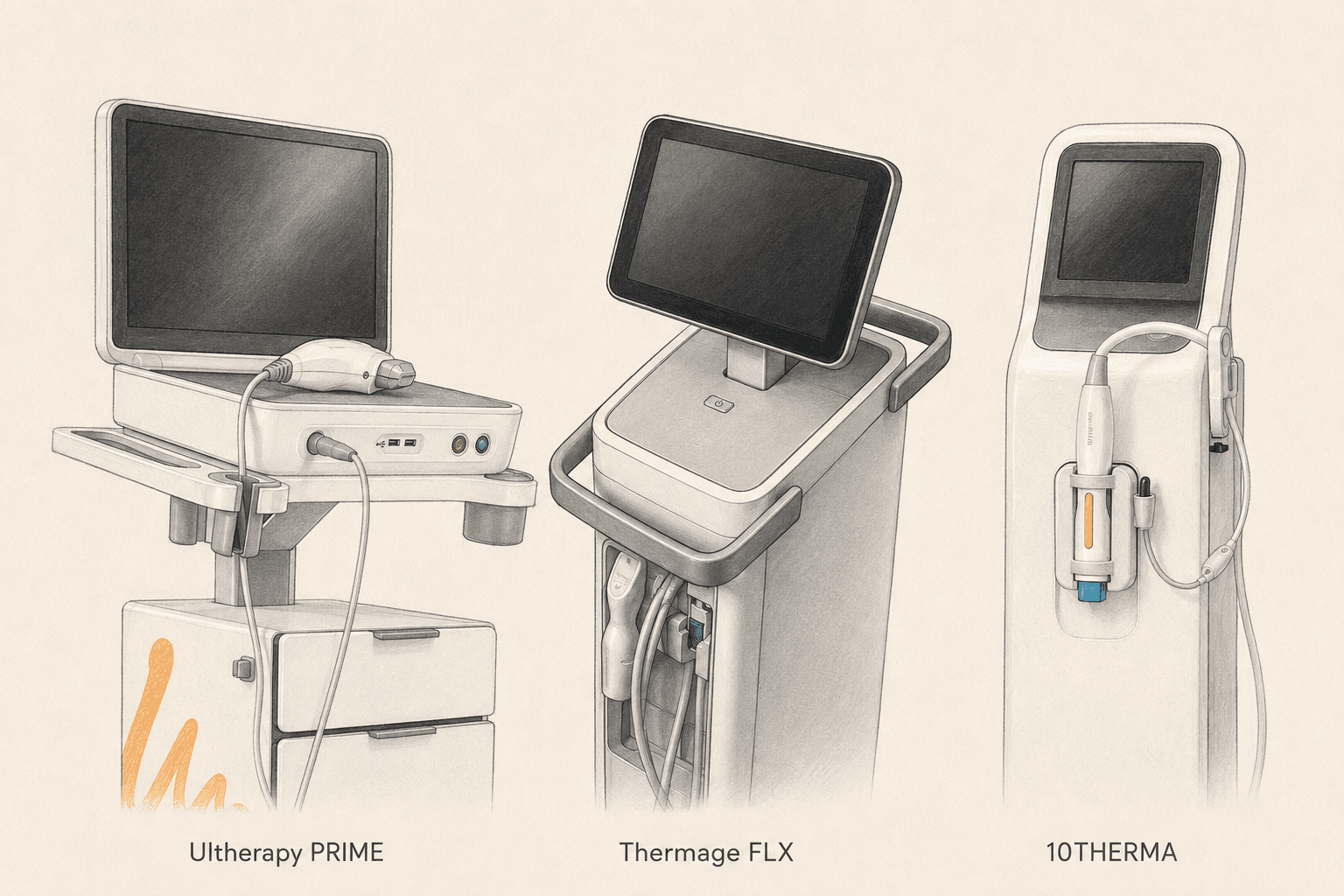
Ultherapy vs Thermage vs 10Therma in Korea
Rejuran in Korea: what a treatment course actually involves
Skin boosters in Korea: types, prices and quote checks
Botox in Korea: what visitors ask, from types to prices
Dermal filler in Korea: areas, products, and how it differs from Botox and boosters
Related treatments
This guide is general information to help you prepare — it is not medical advice. Suitability, the final treatment plan, and pricing are confirmed only by a licensed clinic.
Before you book, verify the clinic yourself
This is general information, not a recommendation of any clinic. Check any clinic on Korea's official foreign-patient registry and use our verification checklist.