
Independent field guide · Compare
HIFU vs Ultherapy in Korea: what is actually different?
Ultherapy is a specific microfocused-ultrasound system with visualization, not the opposite of HIFU — and the Shurink on a Seoul menu is Classys's Ultraformer under its Korean name. Compare the exact device, imaging, area, lines, evidence and written quote before you book.
8 min read · By Glow in Seoul editorial · Updated September 8, 2026
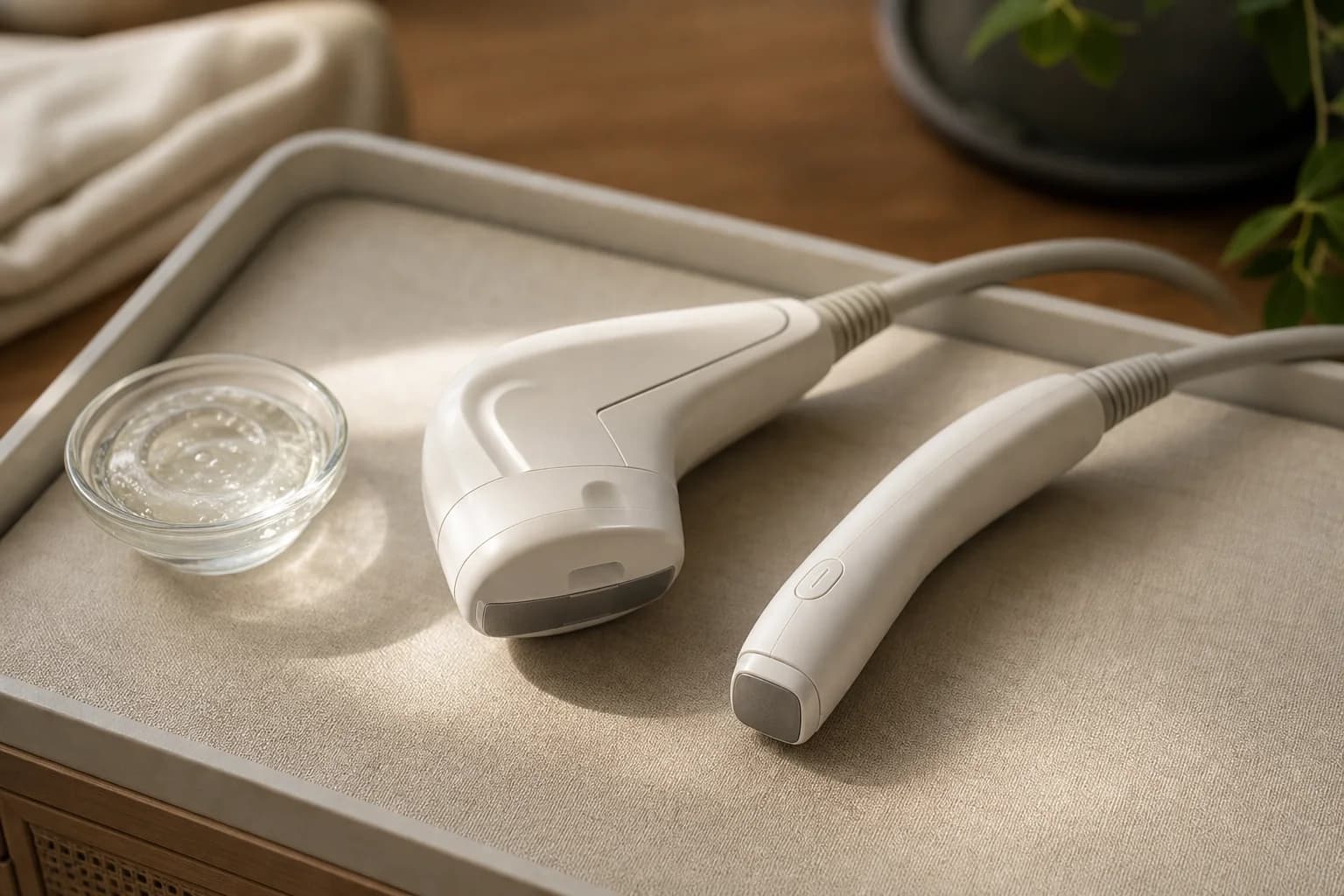
The direct answer: Ultherapy is not a separate energy type competing with HIFU. It is a specific branded microfocused-ultrasound system with visualization (often shortened to MFU-V) within the broader focused-ultrasound family. A Seoul menu that says only "HIFU" may refer to any of several devices and protocols, so the useful comparison is not brand versus category — it is one fully specified treatment plan versus another.
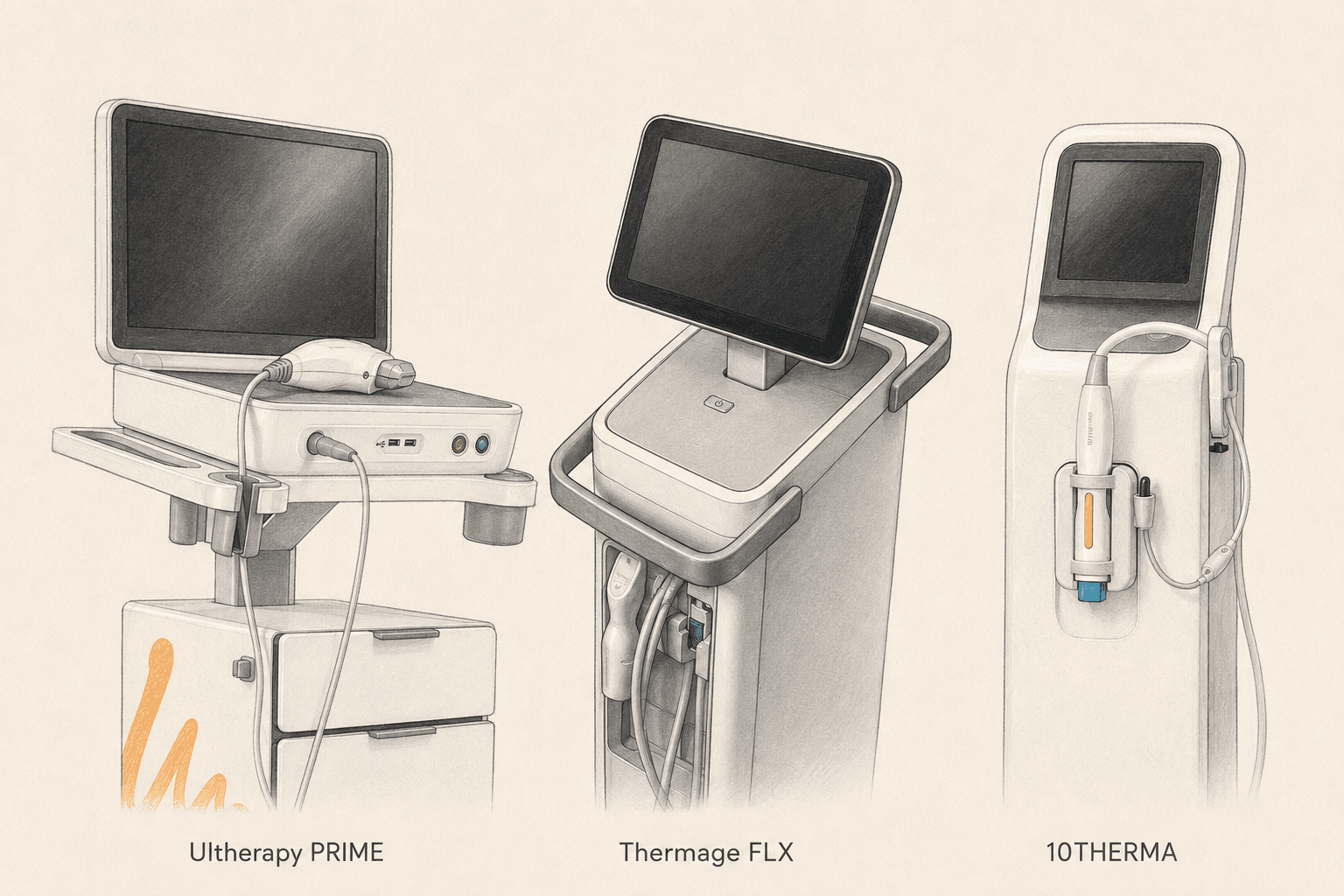
That changes how you compare prices. Ask for the exact device and model, whether the practitioner uses live visualization, the treatment area and depths, the planned lines, who sets and delivers the protocol, and what aftercare is included. A cheaper headline can cover a smaller area or a different system; a premium brand does not by itself prove that the treatment is suitable for your face. If you're comparing ultrasound against radiofrequency, our Ultherapy vs Thermage guide explains how those two energy types differ. 10Therma (텐써마) is not HIFU — it is Korean monopolar RF, the same energy family as Thermage, a different device. For a wider map of how energy lifting compares with injectables, see our treatment comparison overview.
One naming point saves a lot of confusion before you compare anything: the Shurink (슈링크) on almost every Seoul menu is made by Classys and sold overseas as Ultraformer. If you researched Ultraformer at home and then see Shurink in Seoul, those are the same manufacturer's platform under two market names — not a downgrade and not a knock-off.
Section 01
HIFU and Ultherapy, compared correctly
Consumer language makes this sound like a two-product contest. It is not. HIFU is an umbrella term for focused-ultrasound treatments; Ultherapy is one named system. The FDA documentation for the Ulthera System describes focused ultrasound delivered below the skin and a visualization function used to see tissue layers, confirm contact, and help confirm treatment depth. That clearance applies to the named device and its stated indications — not to every treatment sold under the word HIFU.
Other focused-ultrasound devices can have different transducers, imaging capabilities, energy ranges, approved uses, and clinical evidence. Some may be entirely reasonable options. The point is that the category name alone cannot tell you. Ask the clinic to turn the menu label into a device-specific, area-specific plan before you compare it with anything else.
| Question | Generic "HIFU" menu item | Ultherapy / MFU-V |
|---|---|---|
| What does the name identify? | A treatment category; the device may still be unknown | A named focused-ultrasound platform |
| Is visualization included? | Device-dependent — ask for the exact model and function | The Ulthera system includes ultrasound visualization described in its FDA documentation |
| Can evidence be assumed? | No; evidence and authorization are device- and indication-specific | Published evidence exists for MFU-V, but it still does not predict an individual result |
| Can line counts be compared directly? | Not without device, depth, area, and protocol | Only within a fully specified Ultherapy plan; more lines alone do not prove a better plan |
| Does the label decide suitability? | No | No — a clinician still needs to assess anatomy, laxity, goals, and risk |
This table compares what the labels tell you, not which treatment you personally should receive. Suitability and settings require an in-person medical assessment.
Section 02
Shurink is the name you will actually see in Seoul
Korean clinic menus rarely write "HIFU." They write a device name — and the one you will meet most often is Shurink (슈링크). If you researched focused ultrasound in English before your trip, you probably met the same platform under a different name: Classys, the Korean manufacturer, sells it as Ultraformer abroad.
The company's own corporate history states both names together: it lists "SHURINK (ULTRAFORMER III)" and, for the newer platform, records MFDS approval of "SHURINK UNIVERSE (ULTRAFORMER MPT)" in October 2021. So a Seoul menu offering Shurink Universe and an overseas clinic offering Ultraformer MPT are naming the same manufacturer's platform, not two rival technologies.
This matters for one practical reason: it removes a false comparison. Shurink is not a cheaper imitation of Ultherapy, and Ultherapy is not a premium version of Shurink. They are separate devices from separate manufacturers — Classys and Merz — and each has its own model generations, cartridges and approved uses. Whichever appears on your quote, the questions stay the same: which exact model, which cartridge depths, which area, and how many lines.
| Name on a Seoul menu | Name you may know from abroad | Manufacturer | What to still ask |
|---|---|---|---|
| 슈링크 / Shurink | Ultraformer III | Classys | Which generation is installed, and which cartridges are planned |
| 슈링크 유니버스 / Shurink Universe | Ultraformer MPT | Classys | Same — model and cartridge depths for your area |
| 울쎄라 / Ultherapy | Ultherapy | Merz | Whether live visualization is used during your treatment |
| "HIFU" with no device named | — | Unknown until you ask | Which device and model, before comparing any price |
A name-matching table so you can tell whether two quotes describe the same platform. It does not rank the devices or indicate which is suitable for you.
Section 03
What the evidence can — and cannot — tell you
Systematic reviews of microfocused ultrasound report improvement in selected patients with mild-to-moderate facial laxity, usually developing over the months after treatment. They also flag important limits: studies used different devices and protocols, objective outcome measures were inconsistent, many samples were small, and one major review included only women. That is enough to say the modality has clinical evidence; it is not enough to declare every device, protocol, or patient equivalent.
The evidence therefore supports a narrower conclusion than clinic marketing often suggests: a specified focused-ultrasound treatment can be useful for selected patients, and results are generally gradual. It does not establish that Ultherapy is always superior to a Korean device, that a cheaper device is equivalent, or that a high line count guarantees a visible lift. Those claims require device-specific evidence and an individual assessment.
Section 04
Turn two prices into comparable written quotes
A useful quote is a treatment specification, not just a total. If one clinic cannot supply the fields below, you do not yet have enough information to compare it with another clinic's offer.
| Quote field | Why it changes the comparison | Question to send |
|---|---|---|
| Exact device and model | "HIFU" can name multiple systems with different functions and evidence | What is the full manufacturer and model name? |
| Treatment area | Lower face, full face, under-chin, and neck are not the same scope | Which exact areas are included and excluded? |
| Depths / cartridges | A protocol can distribute lines at different tissue depths | Which cartridge depths are planned, and who decides them? |
| Lines or shots | Count affects scope, but is meaningful only with device, depth, and area | How many lines are planned for each area and depth? |
| Visualization | Imaging availability and use vary by system and protocol | Does this device visualize tissue during treatment, and is it used for my session? |
| Operator and assessment | The plan depends on who assesses anatomy and who delivers energy | Which doctor assesses me, who performs the procedure, and who sets the protocol? |
| Included care and total | Numbing, tax, aftercare, and follow-up can sit outside the headline price | What is the written total, including every required add-on? |
Section 05
Why line count is not a universal score
A line count can help compare two quotes for the same device, area, and protocol. Outside that context it becomes misleading. Different devices can define and deliver a line differently; the same total can be distributed across different depths or areas; and an unnecessarily large number is not automatically safer or more effective.
Use the count as one field in a specification, not as a quality score. The clinically relevant question is whether the chosen depths, placement, and energy suit the anatomy being treated. Glow in Seoul cannot infer that from a menu or a photograph, and neither can a salesperson before a doctor has assessed you.
Section 06
Pain, visible downtime, and travel timing
Reviews of MFU and MFU-V commonly report treatment pain and short-lived redness, swelling, bruising, or tenderness. Less common adverse events have also been reported, which is why this remains a medical procedure rather than a zero-risk facial. The exact experience depends on the device, area, settings, pain management, and the individual.
Do not schedule from a generic promise of "no downtime." Ask what may be visible at 24 hours, three days, and one week for the proposed protocol; what symptoms require contacting the clinic; and who provides follow-up after you leave Korea. Results are assessed over weeks to months, so a treatment immediately before a flight or event does not create an instant final lift and leaves little room to manage an unexpected reaction.
Section 07
The decision rule to use in consultation
Do not ask only, "Which is better, HIFU or Ultherapy?" Ask the doctor to explain why a named device and protocol fit your anatomy and goal, what the realistic alternative is, and what evidence supports that exact device. If the answer stays at the level of "premium" versus "budget," you still have a sales comparison rather than a medical plan.
A good consultation can also end with neither option. Focused ultrasound is not the answer to every kind or degree of laxity, and a responsible clinician should be able to explain when expected improvement is too limited, when another modality is being considered, or when treatment should be deferred.
Frequently asked
Frequently asked
Is Ultherapy the same as HIFU?
Ultherapy is in the focused-ultrasound family, so it is commonly grouped under HIFU in consumer language. More precisely, it is a named microfocused-ultrasound system with visualization (MFU-V). HIFU by itself is an umbrella label that can refer to multiple devices, so ask for the exact model before comparing treatments.
Is Ultherapy better than Korean HIFU?
There is no responsible universal answer. Ultherapy has a specified platform, visualization, regulatory documentation, and a published evidence base; Korean focused-ultrasound devices differ from one another in design, functions, authorization, and evidence. A comparison has to name the exact alternative device, area, protocol, and operator — then a doctor assesses which, if either, fits you.
Why is Ultherapy more expensive than some HIFU treatments in Seoul?
The brand and platform are part of the difference, but the quote can also cover a different area, number and distribution of lines, cartridges, pain management, and follow-up. A low headline price may be a small-area or low-line plan. Get both offers in writing with the exact device, area, depths, line count, operator, inclusions, tax, and total before comparing them.
How many HIFU or Ultherapy lines do I need?
There is no universal number. The useful count depends on the device, anatomy, treatment area, depths, and protocol. Counts are most comparable only when those variables are the same. A doctor should assess you and explain the distribution by area and depth rather than sell a number as a quality score.
Does HIFU or Ultherapy have downtime?
Visible downtime is often limited, but it is not guaranteed to be zero. Reviews commonly report temporary redness, swelling, bruising, tenderness, and treatment pain, with less common adverse events also reported. Ask the clinic what may be visible at 24 hours, three days, and one week for the exact proposed device and settings, and how follow-up works after you travel.
Should I choose HIFU or Ultherapy before I arrive in Korea?
Choose what information to collect, not your final medical protocol. Request the exact device, area, depths, lines, total price, operator, and follow-up in advance. The final choice and settings should follow an in-person assessment; a credible clinic should also be willing to say that neither option is a good fit.
Related guides
Related guides



Related treatments
References
Notes & sources
This guide is general information to help you prepare — it is not medical advice. Suitability, the final treatment plan, and pricing are confirmed only by a licensed clinic.
Before you book, verify the clinic yourself
This is general information, not a recommendation of any clinic. Check any clinic on Korea's official foreign-patient registry and use our verification checklist.