
Independent field guide · Treatments
Ultherapy vs Thermage vs 10Therma in Korea
Understand ultrasound and radiofrequency, keep lines and pulses distinct, and compare the scope behind a Seoul clinic quote.
7 min read · By Glow in Seoul editorial · Updated September 7, 2026
Start with the essentials
Ultherapy uses focused ultrasound with visualization; Thermage and 10Therma use monopolar radiofrequency (RF). They are distinct devices, and their counts do not establish equivalent treatment. To compare a Korean clinic quote, check the exact model, named areas, quantity and original unit, visits, and total inclusions before considering the headline price. [1][4][5]
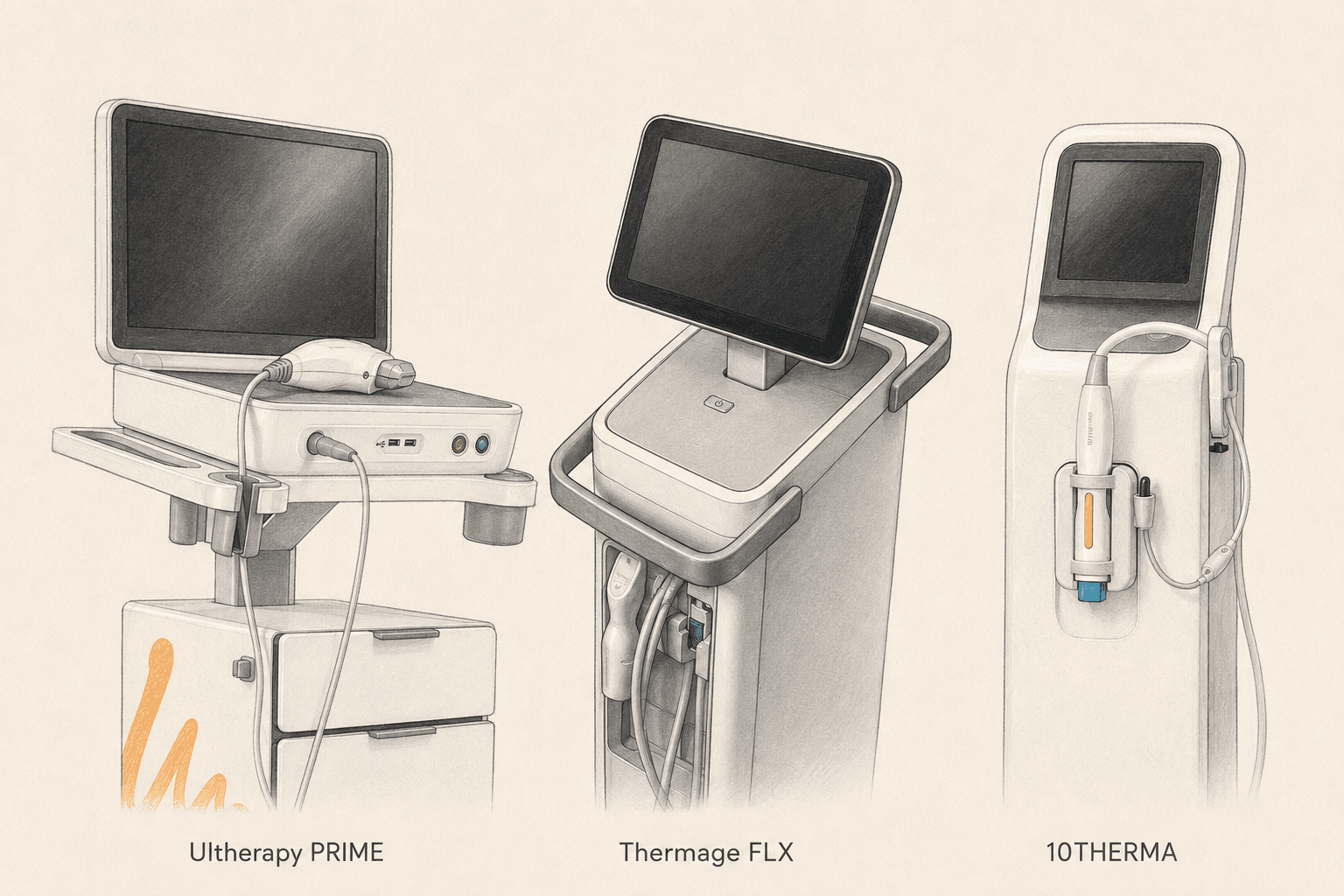
The useful question is what each clinic is actually proposing for you. Use these tables to prepare for a consultation, or bring the original wording into Analyze. Check the extracted fields before comparing two offers.
Section 01
Start with the exact device
The FDA describes the Ulthera system as focused ultrasound with supplementary imaging. Its PRIME instructions distinguish imaging from treatment delivery. Thermage's manufacturer identifies its technology as monopolar RF; the FLX regulatory document describes delivery through a treatment tip with cooling. These describe how the systems work, not which result you will get.
TENTECH identifies 10THERMA as monopolar RF and lists 10THERA separately as HIFU. The final M matters. A menu saying 'Korean Thermage' still needs an actual manufacturer and model. Sharing an energy category does not make two brands or their consumables interchangeable.
| Name on the menu | Energy / identity | Clarify before comparing |
|---|---|---|
| Ultherapy / Ulthera | Focused ultrasound with visualization | PRIME or another model? Which areas and line count are included? |
| Thermage | Monopolar RF | Which model, such as FLX? Which area-specific tip and stated treatment count? |
| 10Therma / 텐써마 | TENTECH monopolar RF | Confirm 10THERMA, its tip, areas and count; do not substitute Thermage details. |
| HIFU / RF lifting | Broad technology labels | Ask for the full device name. A category does not identify the purchase. |
US regulatory documents are used for device descriptions. They do not establish a clinic's Korean approval, intended use or patient suitability; ask for the proposed device's local labeling.
Section 02
Keep lines, shots and pulses in their original units
A count needs context. Ultherapy PRIME instructions distinguish lines delivered during treatment from a transducer's remaining capacity. Ask whether a quoted number describes the treatment planned for you, a component's capacity, or a package split across areas. Do not turn one into the other.
Keep the clinic's unit, whether lines, shots, pulses or REPs, and ask what it counts on that device. Do not divide prices by unlike counts to declare a better deal. Model, area, consumable and scope still need to match; energy settings and suitability require the treating clinician's judgment.
| Field | Fictional quote A | Fictional quote B |
|---|---|---|
| Exact wording | Ultherapy PRIME 300 lines, jawline, 1 visit | Thermage FLX 600 pulses, full face, 1 visit |
| Quantity to preserve | 300 lines | 600 pulses |
| Area | Jawline | Full face — boundaries still need confirmation |
| Price / tax / extras | Not stated | Not stated |
| What you can conclude | Different device, unit and area | Cannot be called twice the treatment or better value |
Invented examples for reading quotes, not treatment protocols, recommended counts or market offers. Enter each in a separate Analyze quote field; review and correct the extracted information.
Section 03
What does comparative research actually tell us?
A 2019 randomized, evaluator-blinded split-face study enrolled 20 people with mild to moderate laxity. It compared microfocused ultrasound with visualization against monopolar RF through six months. The abstract reports improvement with both and no statistically significant between-treatment difference on its reported outcomes.
That small study does not prove equivalence or a universal winner. The abstract does not identify today's PRIME and FLX generations, so we cannot present it as a current-model head-to-head. We reviewed the abstract, not the full text, and cannot assess every method or funding detail from it.
Section 04
Compare the purchase behind the Seoul price
We do not have a current, verified Seoul price survey for matching models and treatment scopes. A broad price band would hide the differences you need to see. Request dated, itemized quotes in the original currency, then send each clinic the same questions.
| Check | Question to send |
|---|---|
| Device and consumable | What is the full system/model name, and which tip or transducer is proposed? |
| Quantity and area | What does the stated count measure, and which named areas does it cover? |
| Visits | Is this one visit, a package, or an initial visit with further treatment proposed? |
| Tax and extras | What is the total payable including tax, consultation, pain management and required extras? |
| Changes after examination | What might change, and will I receive the revised total before deciding? |
| Aftercare | What follow-up is included, and who answers concerns after I leave Korea? |
Keep unconfirmed fields blank. A per-count price can describe an offer; it cannot establish medical value or equivalent results across devices.
Section 05
Plan around your dates, not a 'no downtime' promise
The manufacturers describe possible adverse effects: Ultherapy instructions include pain, swelling and transient nerve effects; Thermage safety information includes pain, swelling and burns. This is not a complete list or a comparison of rates. A reassuring menu phrase cannot replace device-specific screening and consent.
Tell the clinician about relevant medical history and implants, your event or photo date, departure, and access to follow-up. Ask which reactions and less common complications matter for the proposed treatment, what to do if they occur, and whether your schedule makes postponement more sensible. This guide gives no fixed recovery or safe-to-fly interval.
If a clinic suggests combining ultrasound and RF, ask why both are proposed, what each adds, what alternatives exist, and how the total and follow-up change. A package name alone is not a reason to schedule both together.
Section 06
Turn the reply into a clearer comparison
Keep a dated copy of each quote, including a source link or screenshot. In Analyze, enter offers separately, preserve the exact model and unit, and correct missing or misread fields. The tool organizes stated information; it does not authenticate a device or decide suitability.
Use the clinic verification checklist for the clinic's identity and registered name. When a clinic answers, update the saved comparison from Recent plans. A clearer question, a consultation, or a decision to wait can all be useful outcomes.
Frequently asked
Frequently asked
What is the main difference between Ultherapy and Thermage?
Ultherapy uses focused ultrasound with visualization; Thermage uses monopolar RF. The exact system, area and proposal matter. Energy type alone does not establish which option is suitable or more effective for you.
Is 10Therma the same as Thermage or 10Thera?
No. 10THERMA is TENTECH's monopolar RF device. Thermage is a separate brand, and TENTECH lists 10THERA as a separate HIFU device. Confirm the complete name rather than a shorthand menu description.
Can I compare 300 Ultherapy lines with 600 Thermage pulses?
Record them side by side, but the numbers do not establish equivalent treatment or a two-to-one effect. Keep each original unit and confirm the device, count definition, areas and consumable with the clinic.
Which is cheaper in Korea?
This guide has no current verified survey of equivalent Seoul offers. Compare dated, itemized quotes for the exact model, areas, quantity, visits, tax and extras. A lower headline price may cover a different purchase.
Can I book either treatment immediately before a flight or event?
Ask the clinician to assess the proposal against your dates, possible reactions and follow-up needs. Neither a 'minimal downtime' claim nor a planning tool guarantees recovery or medical clearance to fly.
Should I combine Ultherapy and Thermage?
Ask why both are proposed after your examination, what each is intended to add, and how risks, alternatives, price and follow-up differ. A combination package is not automatically necessary or appropriate.
Related guides
Related guides


References
Notes & sources
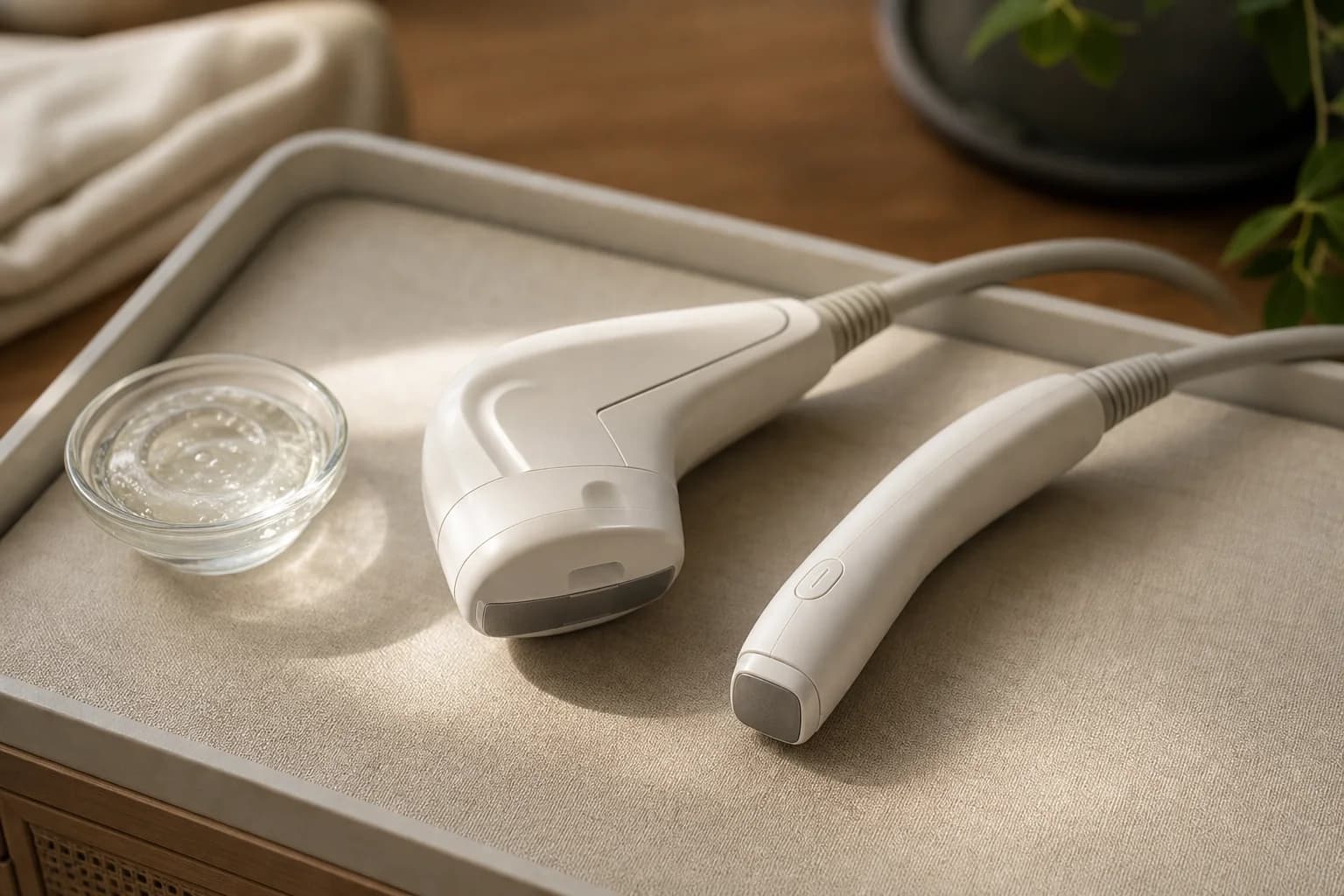
Prepared with AI assistance and editorial source checks on September 7, 2026. Manufacturer documents support device identity and labeled precautions, not a ranking of benefit. The clinical study was checked at abstract level. Quote examples are fictional. No medical review, clinic visit or patient-outcome assessment was performed. The cover is an AI illustration based on manufacturer images, not a clinical photograph or an exact-scale depiction. Cellinique is a paid advertising partner; no clinic is ranked or recommended here. Editorial and advertising disclosure
This guide is general information to help you prepare — it is not medical advice. Suitability, the final treatment plan, and pricing are confirmed only by a licensed clinic.
Before you book, verify the clinic yourself
This is general information, not a recommendation of any clinic. Check any clinic on Korea's official foreign-patient registry and use our verification checklist.