
Independent field guide · Treatments
RF lifting in Korea: Thermage, 10Therma, Oligio, InMode
Monopolar RF for broad tightening, microneedling RF for texture and pores, and where each device category fits — plus how RF differs from HIFU. Neutral device map, directional pricing only; the clinic confirms what's suitable.
7 min read · By Glow in Seoul editorial · Updated August 28, 2026
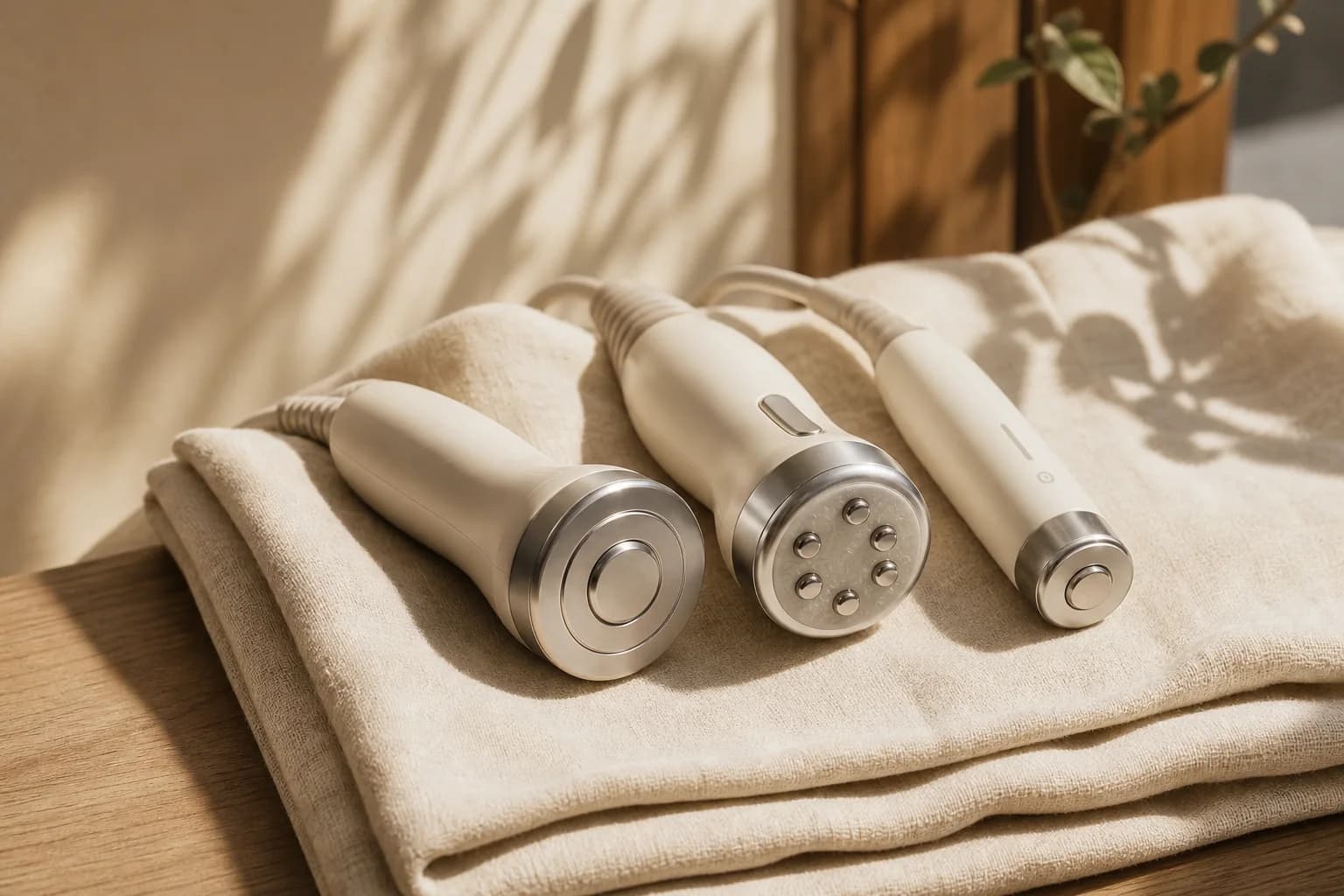
"Thermage," "10Therma" (텐써마), "Oligio," "Potenza," and "InMode" show up on almost every Seoul clinic's treatment menu, and it's easy to assume they're competing versions of the same thing. They're not — they're radiofrequency (RF) devices from different categories that heat the skin differently for different goals: some tighten broadly across a wide area, some work at a targeted depth for texture and pores, and some are multi-modality systems that cover several jobs depending on the handpiece used.
This guide is a neutral device map, not a recommendation of one over another. It covers how RF works and how it differs from HIFU (Ultherapy), where monopolar RF (Thermage, 10Therma, Oligio-type), microneedling RF (Potenza-type), and other multi-modality systems (InMode-type) each fit, plus directional Seoul pricing. A doctor confirms which device, if any, suits your skin and goals — nothing here is a substitute for that consultation.
Section 01
How RF lifting works, and how it differs from HIFU (Ultherapy)
Radiofrequency devices deliver controlled heat into the skin's deeper layers — the dermis, and sometimes the layer just beneath it — which does two things: it causes an immediate, modest contraction of existing collagen, and it triggers new collagen production over the following weeks to months as the skin remodels. That's why RF is commonly discussed for tightening and improving skin quality rather than for a dramatic, immediate lift.
HIFU (high-intensity focused ultrasound), most familiar under the brand Ultherapy, is a different technology aimed at a different depth. It focuses ultrasound energy at a precise point, often reaching the SMAS layer — the fibrous, muscle-connected layer surgeons address in a facelift — while leaving the surface largely undisturbed. RF, by contrast, heats a broader zone closer to the surface. Neither is "better": they're commonly discussed for overlapping but distinct goals, sometimes combined in the same treatment plan, and which one (or both) suits you is something a doctor assesses after examining your skin laxity and goals. Our guide comparing K-beauty treatments covers Ultherapy alongside RF devices if you want the wider map first.
Section 02
The RF device landscape in Seoul
Once you're past the marketing names, most RF devices on a Seoul menu fall into a few categories by how they deliver energy and what they're commonly discussed for. The table below is a neutral map of those categories — not a ranking, and not a recommendation of any one device.
| Device / type | Energy | Commonly discussed for | Downtime | Directional price band (Seoul, per session) |
|---|---|---|---|---|
| Thermage (monopolar RF) | Monopolar radiofrequency, typically delivered in a single comprehensive pass | Broad, non-surgical tightening of face or body; overall skin texture | Low — mild redness or warmth, usually settles within a day | ~$800–2,500+ (varies by shot/tip count) |
| Oligio (monopolar RF) | Monopolar radiofrequency, similar principle to Thermage | Broad tightening; often positioned as more comfortable or quicker to deliver | Low — similar profile to Thermage | ~$400–1,200 |
| 10Therma / 텐써마 (monopolar RF) | Korean monopolar RF — same energy family as Thermage, a different device. The name foreigners usually type. | Broad tightening; often compared with Ultherapy on Seoul menus | Low — mild redness possible | Varies by clinic — confirm the device name on the quote |
| Potenza (microneedling RF) | Fractional radiofrequency delivered through fine needles into the skin | Texture, enlarged pores, acne scarring, mild laxity | Moderate — redness and pinpoint scabbing common for a few days | ~$250–700 |
| InMode-type systems (various handpieces) | RF in several forms depending on the specific device — subdermal, fractional/microneedling, or body-focused | Depends on the exact handpiece: tightening, texture, or body contouring | Varies by handpiece — the clinic specifies for the exact device used | Varies widely — confirm per device |
Directional price bands only, in USD — not quotes and not clinic-specific. Actual price depends on the specific device generation, tip/shot count, area treated, and number of sessions; the clinic confirms after assessing you.
Section 03
Monopolar RF: Thermage and Oligio-type devices
Both work on the same principle: monopolar radiofrequency energy passed through the skin, usually in a single comprehensive session rather than a multi-visit course, heating a broad area to encourage tightening and gradual collagen remodeling. Thermage has the longer track record and is often discussed for its established history; Oligio and similar newer monopolar RF devices are frequently positioned as more comfortable or faster to deliver, sometimes at a more accessible price. Neither claim makes one device categorically better for a given person — device generation, tip size, and energy settings vary by clinic and are a doctor's call, not a brand comparison.
Sensation is usually described as a series of warm-to-hot pulses, sometimes noted as a brief snap or sting at the moment of delivery, dialed to a level that's noticeable but tolerable; numbing cream beforehand is common. Downtime is generally low — mild redness or warmth that typically settles within a day, so most people return to normal activities right away. Results are not immediate: visible tightening commonly builds over roughly two to six months as new collagen forms, and some clinics offer a touch-up session as part of the plan.
Section 04
Microneedling RF: Potenza-type devices
Potenza and similar microneedling RF devices work differently: fine needles carry radiofrequency energy directly into a targeted skin depth, combining the mechanical effect of microneedling with the heat-driven collagen response of RF. That's why microneedling RF is more commonly discussed for texture, enlarged pores, and acne scarring — concerns that respond to controlled micro-injury and remodeling — than for broad tightening alone, though some improvement in mild laxity is also discussed.
Downtime is more noticeable than monopolar RF: expect redness for a few days and, depending on the needle depth and energy settings used, pinpoint scabbing or grid-like marks that typically resolve within about a week. That makes timing relative to a trip worth planning around — our guide to planning treatments around your dates covers how to sequence downtime-heavy treatments. As with the other categories, needle depth, energy level, and number of passes are calibrated by the treating doctor to your skin and concern, not standardized across everyone.
Section 05
Other RF systems you'll see, and prices in Seoul
"InMode" is a company that makes several distinct RF-based devices and handpieces — some for deeper subdermal heating, some fractional or microneedling-style, some aimed at body areas — so a clinic mentioning "InMode" could mean quite different treatments depending on the specific handpiece and protocol used. It's worth asking for the exact device or handpiece name, not just the company name, since that's what determines the depth, downtime, and what it's actually suited for.
Prices across all these categories vary widely, and a single headline number is misleading. Monopolar RF is often priced as a comprehensive full-face session, sometimes described by shot or tip count, while microneedling RF is more often priced per session as part of a short course. Directionally, expect Gangnam pricing to range from roughly the low hundreds of USD for a single microneedling RF session up to well over a thousand USD for a comprehensive monopolar RF session on higher tip/shot counts — with real variation by device generation and area treated. Every figure here is a reference point, not a quote; the clinic confirms your actual price after an assessment. Our guide on how Korean clinic pricing really works covers common add-ons and hidden costs to watch for.
Section 06
Questions to ask before you book
Because these devices differ so much in depth and downtime, it's worth asking a few specific questions before committing: Which exact device and handpiece will be used — not just the brand or company name? Is this priced as a single comprehensive session or a multi-visit course, and how many sessions does the assessment suggest for your skin? What downtime should you expect this week, and does it fit your travel dates? And is a doctor performing or directly supervising the treatment, rather than a technician alone? A clinic that answers these plainly, before any sales pressure, is a good sign — see our clinic verification checklist for the fuller list.
Frequently asked
Frequently asked
What's the difference between Oligio and Thermage?
Both are monopolar radiofrequency (RF) devices used for broad, non-surgical skin tightening, and they work on a similar principle: heating the deeper skin layers, usually in a single comprehensive session, to trigger gradual collagen remodeling. Thermage has been in use longer and is often discussed for its established track record; Oligio and similar newer monopolar RF devices are frequently positioned as more comfortable or quicker to deliver, sometimes at a more accessible price. Neither is universally better — the right device, settings, and whether it suits your skin at all is something a doctor assesses, not a brand comparison.
What does Potenza treat that Thermage or Oligio doesn't?
Potenza is a microneedling RF device — it delivers radiofrequency energy through fine needles directly into a targeted skin depth, which is why it's more commonly discussed for texture, enlarged pores, and acne scarring than for broad tightening alone. Thermage and Oligio are monopolar RF, delivering energy across a broader area for tightening. Some concerns respond better to one approach than the other, and clinics sometimes combine treatments — a doctor assesses which fits your specific concern.
How is RF lifting different from Ultherapy (HIFU)?
They're both non-surgical energy treatments commonly discussed for tightening, but they use different energy and reach different depths. Radiofrequency (Thermage, Oligio, Potenza, and similar) heats a broader zone at more superficial-to-mid skin depths. Ultherapy uses focused ultrasound (HIFU) aimed at a precise point, often reaching the deeper SMAS layer that surgeons address in a facelift. Neither is categorically better — they're commonly discussed for overlapping but distinct goals, and a doctor recommends one, the other, or both based on your skin laxity and goals.
Does RF lifting hurt, and what's the downtime?
Sensation and downtime vary by category. Monopolar RF (Thermage/Oligio-type) typically feels like a series of warm-to-hot pulses, often with numbing cream beforehand, and downtime is generally low — mild redness that usually settles within a day. Microneedling RF (Potenza-type) tends to have more noticeable downtime — redness for a few days and sometimes pinpoint scabbing — because it creates controlled micro-injury as well as heat. Your clinic sets expectations for the specific device and settings used.
How much does RF lifting cost in Seoul?
Pricing varies widely by device category, generation, area treated, and how the clinic packages sessions, so a single number is misleading. Directionally, a single microneedling RF session (Potenza-type) commonly runs in the low hundreds of USD, while a comprehensive monopolar RF session (Thermage/Oligio-type), often priced by shot or tip count for the full face, can range from several hundred to well over a thousand USD. These are reference ranges, not quotes — the clinic confirms your actual price after assessing you.
How many RF sessions do I need, and how long do results last?
It depends on the device category and your goals. Monopolar RF (Thermage/Oligio-type) is often done as a single comprehensive session, sometimes with an occasional touch-up, since results build from one thorough treatment. Microneedling RF (Potenza-type) is more often done as a short course of several sessions spaced weeks apart, similar to other skin-quality treatments. In both cases, visible tightening commonly builds gradually over roughly two to six months as new collagen forms, with effects commonly discussed as lasting many months before some people choose a repeat session — a doctor gives you a realistic timeline for your skin.
Related guides
Related guides


Related treatments
This guide is general information to help you prepare — it is not medical advice. Suitability, the final treatment plan, and pricing are confirmed only by a licensed clinic.
Before you book, verify the clinic yourself
This is general information, not a recommendation of any clinic. Check any clinic on Korea's official foreign-patient registry and use our verification checklist.