
Independent field guide · Treatments
Collagen stimulators in Korea: Sculptra vs Juvelook vs Radiesse-type, compared
Three different materials, not three brands of one thing: Sculptra is PLLA, Juvelook is PDLLA, and Radiesse-type products are calcium hydroxylapatite — the only one that also adds volume on the day. Decision table with downtime, sessions, timeline, and directional Seoul prices a clinic confirms.
8 min read · By Glow in Seoul editorial · Updated August 17, 2026
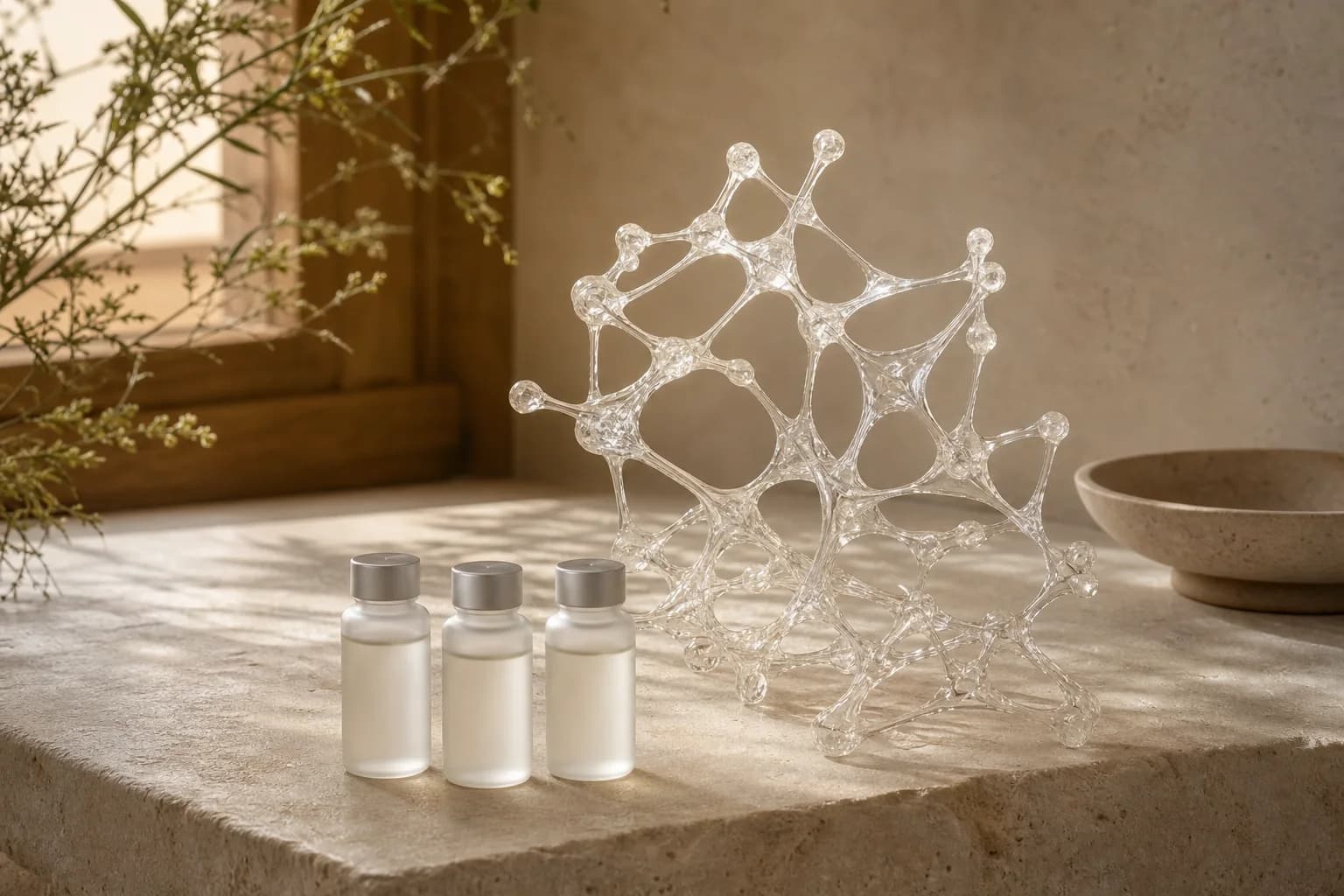
Short answer: a collagen stimulator doesn't fill — it prompts your own skin to produce more collagen over the following months, so little changes on the day of treatment. Three materials cover almost all of them on a Korean menu: Sculptra is PLLA (poly-L-lactic acid) in a diluted suspension, Juvelook is PDLLA (poly-D,L-lactic acid) in a hyaluronic-acid carrier gel, and the Radiesse-type products are calcium hydroxylapatite (CaHA), which unlike the other two also gives structural volume immediately from its gel carrier as well as prompting a collagen response.
All three are a short course rather than a one-off — commonly two to four sessions spaced roughly four to six weeks apart — with minimal downtime, and the change is discussed as building for months after the last session rather than appearing on the day. Directionally in Seoul a session commonly runs from a few hundred USD upward depending on the product, the dilution and how many vials are used, which makes the course total the number to ask for. Those are reference points, not quotes: a doctor confirms which material, dilution and plan suits you, and no clinic can promise a specific outcome.
This guide separates the biostimulator category from its neighbours — HA boosters, filler, and Rejuran — so you know what you're actually asking for, then compares the three materials, the course, the pricing, and what to ask before you book.
Section 01
What a collagen biostimulator actually is
PLLA and PDLLA are biodegradable, biocompatible synthetic materials that have been used in medicine for decades (for example in dissolvable sutures) before being adapted for aesthetic use. Injected into the skin, the microparticles are gradually broken down by the body over months, and that process is understood to prompt fibroblasts — the cells that make collagen — to produce more of it. The practical effect people commonly discuss is a gradual increase in skin firmness and density, rather than an immediate change in shape.
That's the key distinction from filler: a dermal filler (typically hyaluronic acid) physically adds volume the moment it's injected, and you see the result right away. A PLLA or PDLLA biostimulator carries little to no immediate volumizing effect from the injected material itself — what change appears later comes from your own collagen response, which is why clinics describe it as working "with" the body rather than substituting for it. The calcium hydroxylapatite (Radiesse-type) family sits in between: its gel carrier does give structural volume on the day, and the CaHA microspheres are also discussed as prompting collagen afterward. Our guide comparing what each K-beauty treatment does maps where all of this sits next to filler and boosters if you want the wider picture first.
Section 02
Sculptra vs Juvelook vs Radiesse-type, side by side
These share the general idea of prompting your own collagen but differ in the actual material, in whether anything changes on the day, and in how they're diluted and dosed in Korea. None of them does the same job as an HA skin booster (which hydrates), a plain HA filler (which adds volume immediately and then degrades), or a Rejuran-type PDRN injectable (discussed for repair and resilience rather than collagen stimulation specifically) — a clinic may recommend one, a combination, or none of these depending on what you're trying to address.
| Product family | Material | Mechanism category | Immediate effect on the day | Typical downtime | Typical sessions | How results build and how long they're discussed as lasting | What to ask the clinic |
|---|---|---|---|---|---|---|---|
| Sculptra (PLLA) | Poly-L-lactic acid microparticles in a diluted aqueous suspension | Pure biostimulator | Little — any early plumping is from the injection fluid and settles quickly | Minimal — temporary swelling, small bumps or bruising, usually settling within a few days to about a week | Commonly 2–4, roughly 4–6 weeks apart | Collagen response commonly discussed as building over roughly 2–3 months per session; the change is generally discussed as longer-lasting than HA filler, varying by person | How many vials per session, the dilution, and the massage schedule after treatment |
| Juvelook (PDLLA) | Poly-D,L-lactic acid microspheres in a hyaluronic-acid-based carrier gel | Biostimulator with a temporary HA carrier | Modest early plumping from the carrier gel, which fades within days to weeks | Minimal — same pattern as above | Commonly 2–3, roughly 4–6 weeks apart | Collagen response understood to build over the following weeks to months; commonly discussed as outlasting filler, varying by person | Which product and dilution, how many vials, and whether what you'd see early is the carrier rather than the result |
| Radiesse-type (CaHA) | Calcium hydroxylapatite microspheres in a gel carrier; often diluted or hyperdiluted in Korea for skin quality rather than contouring | Volumising filler and biostimulator in one | Yes — the gel carrier adds structural volume immediately | Minimal to low — swelling or bruising for a few days; a diluted skin-quality treatment behaves more like a booster | Often 1–3, weeks apart, depending on whether it's used for contour or diluted for skin quality | Immediate volume from the carrier, with a collagen response discussed as developing over the following months; duration commonly discussed in the region of a year or more, varying by person | Whether it's being used undiluted for contour or diluted for skin quality, and how many syringes |
| Other PLLA/PDLLA products (various brand names) | Similar synthetic, biodegradable microparticle chemistry, sometimes blended with HA in the carrier | Biostimulator | Depends on the carrier | Minimal | Varies by product and protocol | Similar gradual build; specifics depend on the exact product and dilution | The exact product name, what's in the carrier, and why this one rather than an established option |
Directional, neutral descriptions — not medical advice, not a recommendation, and not a claim about the result you personally would get. Products, dilutions, and dosing protocols vary by clinic and by the area treated; a doctor confirms which product suits you and how it's diluted and injected.
Section 03
What a course looks like: sessions, timeline, downtime
Biostimulators are essentially never a one-off. Clinics commonly discuss a short course — often two to four sessions — spaced roughly four to six weeks apart, so the collagen response from each session has time to develop before the next. This spacing is a meaningful planning factor if you're visiting Seoul for a short trip: you may only fit one session in, with the rest of the course to be continued at home or on a return visit, and it's worth asking the clinic what's realistic within your dates.
A session itself is typically quick — numbing cream, then a series of injections across the treatment area, often 20–40 minutes depending on the area and how the product is diluted. Downtime is generally minimal: temporary swelling, small bumps, or bruising at injection sites that usually settle within a few days to about a week, though the swelling pattern can look slightly different from a booster because of how these products are diluted and injected. Clinics commonly advise gentle massage of the treated area on a schedule they specify (this varies by product and clinic, so follow their instructions rather than a generic rule), and to avoid saunas or heavy sweating for a short window. Our guide to planning treatments around your trip covers this kind of timing question in more depth.
Section 04
Prices in Seoul, honestly
Biostimulators sit toward the higher end of injectable pricing in Seoul, reflecting the product cost and that a course typically means multiple sessions rather than one. What you pay is driven by which product, how diluted it is, how many vials or syringes are used, the area treated, and the clinic's positioning — so a single headline number rarely reflects the total cost of a full course. Directionally, a session commonly runs from roughly $300 to $600 or more, with Sculptra-type treatments (often priced per vial) sometimes running higher per session and diluted CaHA skin-quality treatments priced per syringe. Ask for the full course price, not just the first-session price, and confirm how many vials or sessions are included in any package before you commit.
As with any injectable category, be cautious of a price far below the typical range — it may reflect a more diluted product, fewer units, or a different material altogether marketed under a similar name. Our guide on how Korean clinic pricing really works covers the common hidden costs and how to get an itemized quote. Every figure here is a reference point, not a quote — the clinic confirms your actual price after assessing you.
Section 05
Questions to ask before you book
Because "collagen stimulator" spans several materials with different dilutions and protocols, the consultation matters more than the brand name you saw online. Confirm the clinic is a licensed medical clinic where a doctor consults with you and performs or directly supervises the injection — not a counselor selling a package. Ask exactly which product they plan to use and what material it is, how it's diluted, how many sessions the course involves, the total cost in writing, and what results are realistically discussed for your skin and goals — no clinic can promise a specific outcome, since response varies by person.
There's also an official filter: only clinics registered with the government may legally treat foreign patients, and you can verify any clinic on the public lookup at medicalkorea.or.kr. Our verification checklist covers this check in more detail, and the directory lists every registered Seoul skin and cosmetic clinic by district if you want to see who is registered near you. A good result here depends on the right product and dilution for your skin in careful hands, confirmed by a doctor — not on picking a trending name off a menu.
Frequently asked
Frequently asked
What is a collagen stimulator (biostimulator)?
It's an injectable made from a biodegradable material — usually PLLA, PDLLA, or calcium hydroxylapatite — that's understood to prompt your own skin cells to gradually produce more collagen, rather than only adding volume or hydration. Sculptra, Juvelook, and the Radiesse-type products are the names visitors encounter most in Korea. The effect is commonly discussed as building over months rather than appearing immediately, and a doctor confirms whether it suits your skin.
Sculptra vs Juvelook — what's the difference?
Both are biostimulators, but the material and the carrier differ. Sculptra uses PLLA (poly-L-lactic acid) microparticles in a diluted aqueous suspension and is the more internationally established of the two, commonly discussed for gradual volume restoration across broader areas such as cheeks and temples. Juvelook uses PDLLA (poly-D,L-lactic acid) in a hyaluronic-acid carrier gel, so it gives a modest early plumping from the carrier that fades within days to weeks before the collagen response develops. Dilution, dosing, and typical treatment areas differ by product and by clinic protocol — a doctor confirms which is more suitable for your goals.
Is Radiesse a filler or a collagen stimulator?
Both, which is why it sits slightly apart from Sculptra and Juvelook. Radiesse-type products are calcium hydroxylapatite (CaHA) microspheres suspended in a gel carrier: the carrier adds structural volume the moment it's injected, and the microspheres are also discussed as prompting a collagen response over the following months. In Korea it is often diluted or hyperdiluted and used for skin quality and firmness rather than contouring, which changes both how it behaves and how it's priced. Ask the clinic which of the two uses they have in mind for you.
What's the difference between Juvelook and filler?
They do different jobs. A dermal filler (typically hyaluronic acid) physically adds volume the moment it's injected, so the change is visible right away and then gradually degrades. Juvelook carries little immediate volumizing effect beyond its temporary carrier gel — what change appears later is understood to come from your own collagen response building gradually over weeks to months. Some clinics combine the two for different goals, but they're not interchangeable, and a doctor recommends what fits your face.
Is Juvelook the same as Rejuran, exosomes, or a skin booster?
No — they're related in that all of them are aimed at skin quality rather than the immediate volume of a filler, but the mechanism differs. An HA skin booster hydrates; a Rejuran-type PDRN injectable is commonly discussed for skin repair and resilience; an exosome product in Korea is usually an add-on applied after a laser or microneedling session; a collagen biostimulator like Juvelook works by gradually stimulating your own collagen production. Some treatment plans combine more than one of these. Our comparison guide and our skin booster guide cover how each fits together.
How long do collagen stimulator results take, and how long do they last?
Results are gradual by design — commonly discussed as starting to become noticeable some weeks after a session and continuing to build for a few months as your own collagen response develops, with a full course usually spread over several sessions weeks apart. Because the effect comes from your own collagen turnover rather than a filling material that simply degrades, the change is generally discussed as longer-lasting than filler, though how long it holds varies by person and isn't something we can promise — the clinic can walk through what's typically discussed for the specific product used.
Can I start a collagen stimulator course on a short trip to Seoul?
Usually you can fit one session, rarely the whole course, since sessions are commonly spaced four to six weeks apart. Downtime is not normally the constraint — swelling, small bumps, or bruising typically settle within a few days to about a week — but the aftercare is: several products come with a clinic-specified massage schedule for the days afterward, which you'd be following while travelling. Ask the clinic what a single session realistically does on its own, what the massage and aftercare instructions are for that specific product, and whether the remaining sessions can be continued at home.
How much do collagen stimulators cost in Seoul?
Directionally, a single session commonly runs from roughly $300 to $600+ depending on the product, dilution, and area, with Sculptra-type treatments (often priced per vial) sometimes running higher per session. Because a full course is usually two to four sessions, the course total — not the first-session price — is what matters for budgeting. These are reference ranges, not quotes; the clinic confirms your actual price after assessing you and explaining what's included.
Related guides
Related guides


Related treatments
This guide is general information to help you prepare — it is not medical advice. Suitability, the final treatment plan, and pricing are confirmed only by a licensed clinic.
Before you book, verify the clinic yourself
This is general information, not a recommendation of any clinic. Check any clinic on Korea's official foreign-patient registry and use our verification checklist.