
Independent field guide · Seoul Beauty Culture
Why do Koreans look younger? What science and beauty culture explain
There is no single Korean anti-aging secret. Separate skin-aging biology, UV and smoking evidence, daily maintenance, styling, procedures, and media selection before copying a myth.
8 min read · By Glow in Seoul editorial · Updated July 29, 2026
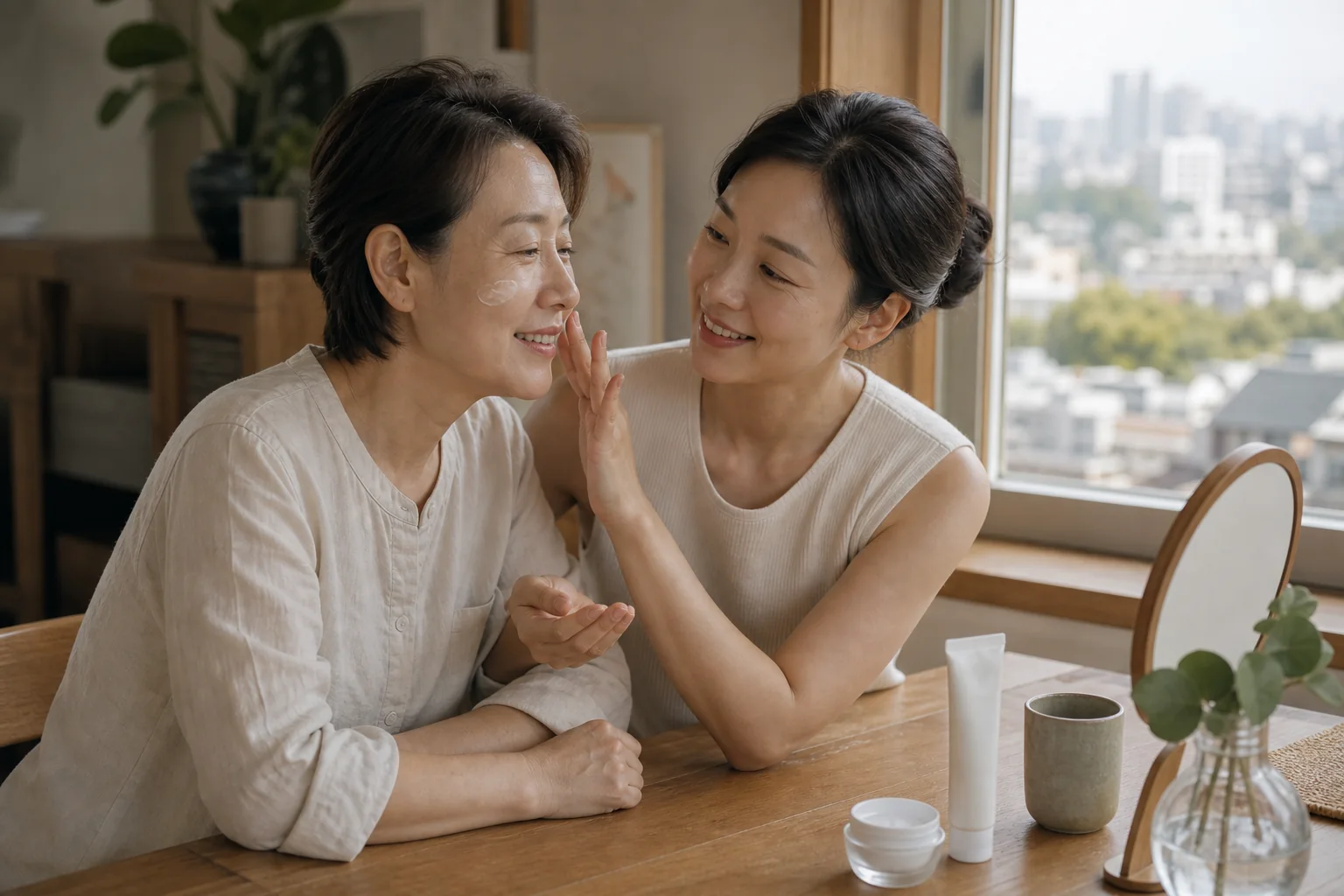
The direct answer: Koreans do not share one anti-aging gene or a national routine that makes everyone age slowly. The younger-looking impression some visitors report is more plausibly a mixture of how photoaging appears in different skin, cumulative sun exposure and smoking, consistent skincare, Seoul's visible maintenance culture, styling, and the highly selected people shown in entertainment and social media.
That distinction matters because perceived age is not biological age. A face can read as younger because of even tone, hair, brows, makeup, clothing, expression, lighting, or a recent procedure without any change to the body's underlying aging. This guide separates what studies actually measured from what is reasonable cultural context and what remains a stereotype.
Section 01
First, 'looking young' is a perception
When someone says Koreans look young, they are usually comparing a guessed age with a chronological age. That guess uses many cues at once: wrinkles and pigment, but also hairstyle, clothing, makeup, facial expression, body language, camera treatment, and the age range of the people they happen to meet. It is not a clinical measurement of how fast an entire person is aging.
The sample is also unusually selective. International audiences often encounter Korean actors, idols, creators, skincare advertising, and polished Seoul neighborhoods before they encounter a representative cross-section of the population. Celebrities have professional lighting, styling, makeup, image editing, and access to care. Treating that group as a national average creates the conclusion before the biology is even considered.
| Possible contributor | What evidence can support | What it cannot prove |
|---|---|---|
| UV exposure and smoking | Both are linked to visible skin aging; Korean photodamage data exist | That every Korean avoids sun or smoking |
| Skin-aging pattern | Wrinkles and pigment can manifest differently across populations and facial sites | That Koreans have a slower biological clock |
| Daily skincare | Moisturising and sun protection can improve or preserve visible skin qualities | That ten steps are necessary or that everyone follows them |
| Styling and media | Hair, makeup, clothes, lighting, and selection alter age judgments | A biological anti-aging effect |
| Aesthetic procedures | A procedure can change selected visible features | That most Koreans receive procedures or that any procedure suits you |
A map of plausible contributors, not a formula for predicting an individual's age or treatment history.
Section 02
The strongest evidence is ordinary: UV and smoking
A study of 407 Koreans found that lifetime sun exposure tracked with wrinkles and that smoking was an independent wrinkle risk factor with an additive effect alongside aging and sun exposure. The same study also found pigmentary changes mattered, pushing back on the simple idea that Asian skin only pigments and does not wrinkle. It measured associations in a Korean sample; it did not compare a national beauty routine with another country.
The intervention evidence comes from elsewhere but is stronger for cause and effect. In a randomized community trial of 903 Australian adults, the group instructed to use broad-spectrum sunscreen daily showed 24% less measured skin-aging progression over four and a half years than the discretionary-use group. That does not prove Koreans look younger because they use sunscreen. It does show why consistent UV protection is a much more defensible explanation for preserved appearance than a secret ingredient or nationality.
Section 03
Different-looking aging is not slower aging
Skin structure, pigmentation, facial anatomy, environment, and behavior can change which aging signs become noticeable first. A comparative study of German, Japanese, and Chinese women found that wrinkles and pigment spots varied by population, age, and facial or body site — and that the two East Asian groups were not interchangeable. That is the important scientific lesson: visible aging has multiple patterns, including substantial variation within East Asia.
So a careful answer can say that inherited traits may influence how wrinkles, pigment, volume, or facial contours are perceived. It cannot leap from that to 'Koreans age slower.' Chronological aging still happens, studies of one East Asian population do not automatically describe Koreans, and group averages never tell you how one person will look.
Section 04
Where Seoul beauty culture probably enters
Seoul makes maintenance unusually visible. Skincare is a mainstream consumer category, sun protection is easy to buy, and dense beauty districts put facials, dermatology, devices, and injectables into ordinary commercial streets. Our clinic-registry analysis shows how concentrated that market is, especially in Gangnam and Seocho. This can normalize starting with small, repeated maintenance choices rather than waiting for one dramatic correction.
That is cultural and market context, not a population study. It does not mean every Korean has a long routine, visits a clinic, or wants to look young. It also has a less flattering side: constant appearance pressure, marketing, and early intervention can make optional beauty work feel compulsory. A useful column should explain both the access and the pressure, not turn either into a national virtue.
Section 05
Consistency matters more than the famous ten steps
The export version of K-beauty often reduces Korean skincare to a ten-step routine. There is no evidence that the number ten has anti-aging power. A cleanser that does not irritate, a moisturiser that supports the barrier, and sunscreen used consistently are more defensible foundations than stacking many products that duplicate each other or trigger irritation.
A study of perceived age in 250 Chinese women found associations with less sun exposure, indoor work, moderate activity, and more frequent use of basic facial-care products. It is useful adjacent evidence about appearance, but it is not a Korean experiment and cannot rank causes. The honest takeaway is narrower: repeated, tolerable habits can affect how skin looks; an elaborate national ritual is not required.
Section 06
What a visitor can actually copy
Copy the decision pattern, not an imagined Korean face. Use broad-spectrum sunscreen in a way you can sustain, avoid smoking, keep the routine simple enough to repeat, and judge products by function rather than step count. If a visible concern needs medical assessment, ask a licensed doctor for a plan instead of assuming that whatever looks common in Gangnam is suitable for you.
Also leave room for ordinary aging. Looking younger is not a health outcome or a moral achievement, and looking one's age is not a failure. Seoul beauty culture is interesting precisely because it shows how biology, habit, commerce, and aesthetics interact — not because it reveals a trick everyone else should chase.
Frequently asked
Frequently asked
Why do Koreans look younger than their age?
There is no single proven reason. The impression can combine visible skin-aging patterns, cumulative UV exposure and smoking, consistent skincare, styling, access to beauty services, and selection bias from seeing polished celebrities and creators. Perceived age is a visual judgment, not a measure of biological aging, and none of these factors describes every Korean.
Do Koreans or Asians age slower genetically?
That is too broad. Research shows that wrinkles, pigmentation, and other visible signs can appear in different patterns across populations, ages, and facial sites, with meaningful differences even between East Asian groups. Inherited traits can affect appearance, but they do not establish a slower national or racial biological clock, and group averages cannot predict an individual.
Is sunscreen the Korean anti-aging secret?
Sunscreen is not uniquely Korean, but regular UV protection has unusually solid evidence. A randomized trial found 24% less measured skin-aging progression in the daily-sunscreen group over four and a half years, and Korean photodamage research linked cumulative sun exposure with wrinkles. That supports sunscreen as a practical habit; it does not prove national differences in use.
Does a ten-step Korean skincare routine prevent aging?
There is no evidence that ten steps are necessary or inherently better. A gentle cleanser, suitable moisturiser, and consistent broad-spectrum sunscreen form a more defensible base. Extra products can target a specific need, but duplicated actives and irritation can work against the goal. Consistency and tolerance matter more than the number of bottles.
Do Koreans start cosmetic procedures younger?
Seoul has a dense and highly visible aesthetic market, so visitors may encounter preventive language and lower-friction access more often. That does not prove most Koreans start procedures young; reliable population-wide, procedure-specific data would be needed. A common menu or social trend is not a reason to treat, and suitability still requires an individual medical assessment.
Which Korean beauty habits have the best evidence?
The least glamorous ones: reduce cumulative UV exposure with usable sun protection, do not smoke, use a simple routine that protects the skin barrier, and seek medical assessment for a medical concern. Products and procedures can help selected goals, but there is no evidence-based national formula that stops aging.
Related guides
Related guides
References
Notes & sources
This guide is general information to help you prepare — it is not medical advice. Suitability, the final treatment plan, and pricing are confirmed only by a licensed clinic.
Planning a Seoul clinic visit?
Build a Visit Plan around your dates — trip fit, directional budget, and a doctor-ready brief.