
Independent field guide · Treatments
Laser treatments in Korea: toning, pigmentation, darker skin, and resurfacing
Compare Korean laser treatments by the concern, exact device, wavelength or mode, skin tone, downtime, and full course — not by a menu name or a cheap single-session price.
9 min read · By Glow in Seoul editorial · Updated July 29, 2026
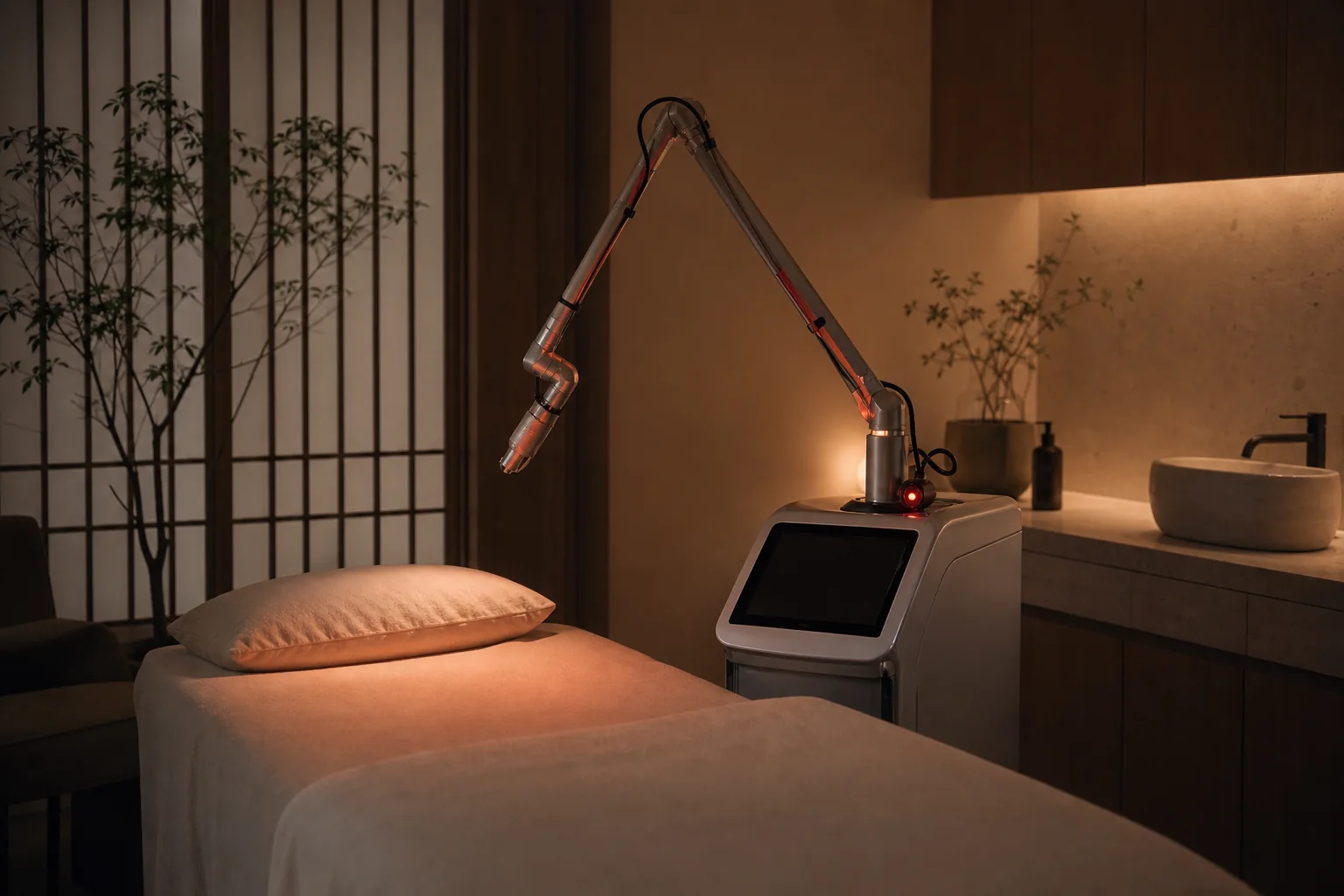
Seoul clinic menus list laser names — toning, IPL, fractional, Fraxel, Picosecond, CO2 — as if they're competing versions of one machine. They're not. Lasers in Korea are grouped by the job they do: some target uneven pigmentation for a more even tone and clarity, some target redness and visible small vessels, and some resurface the skin's texture to soften acne scarring and fine lines. Picking a laser starts with naming your actual concern, not picking a brand name off a menu.
This guide maps the three broad categories by job, gives directional downtime and price bands, and explains what a realistic course looks like. It does not recommend a specific laser, device, or number of sessions for you — that's a diagnosis and a treatment plan, and both are a doctor's call after they examine your skin in person.
Section 01
Lasers, mapped by job
Instead of memorizing device names, start from what you're trying to address. Clinics generally group lasers into three working categories, and a single visit sometimes combines more than one if you have more than one concern.
This table is a map, not a menu to self-prescribe from. Skin type, the specific diagnosis (for example, which type of pigmentation), and how your skin responds to a test spot all change which laser and settings a doctor actually uses.
| Laser category | Commonly used for | Downtime | Directional price band (USD) | Typical course |
|---|---|---|---|---|
| Toning / pigment lasers (e.g. low-fluence Q-switched, picosecond, tone-focused settings) | Uneven pigmentation, overall tone evenness and clarity | Often none to minimal — some redness for hours | ~$50–200 / session | Often a course of 5–10+, spaced 1–4 weeks apart |
| IPL / photofacial | Broadband light for uneven tone, sun damage, mild redness, and diffuse pigment | Low — brief redness or mild bruising possible at treated spots | ~$100–300 / session | Often 3–6, spaced several weeks apart |
| Targeted vascular laser (e.g. long-pulsed Nd:YAG, PDL) | Individual visible small facial vessels and persistent redness | Low — brief redness or bruising possible at treated spots | Priced per session by area and device — ask the clinic | Varies by extent |
| Fractional / resurfacing lasers (non-ablative and ablative types) | Skin texture, enlarged pores, fine lines, acne scarring | Varies — non-ablative is often days; deeper ablative can be a week or more of visible healing | ~$150–600+ / session | Often 3–6+ for non-ablative; deeper resurfacing may be fewer, more spaced-out sessions |
Directional ranges commonly reported in Gangnam, in USD — not a quote and not clinic-specific. The doctor determines which category (or combination), the specific device, and the session count after examining your skin.
Section 02
Toning and pigment lasers: for uneven pigmentation and clarity
This category is aimed at uneven pigmentation — flat brown spots, sun-related pigmentation, and general unevenness in tone — with the goal of a more even, clearer-looking complexion. It is not about making skin lighter than its natural tone, and a clinic should not frame it that way; the goal is evenness, not a shade change.
Pigmentation is not one condition. Sun spots, freckles, and post-inflammatory marks behave differently from melasma, a hormonally influenced pigmentation pattern that commonly recurs and can worsen if treated with the wrong approach or too aggressively. Because of this, an accurate diagnosis matters more here than in almost any other category — what looks like a simple sun spot to the eye can be melasma or a mix of both, and the treatment plan differs. This guide does not recommend a specific laser, energy setting, or number of sessions for pigmentation; that's a call the doctor makes after diagnosing what type of pigmentation you actually have, and it's commonly discussed as a gradual, multi-session process rather than a single treatment.
Because pigmentation lasers are often low-downtime, it's tempting to treat them as casual. They're still a medical procedure with real risk if the diagnosis is wrong — including the pigmentation returning or getting worse. Ask the clinic directly what type of pigmentation they believe you have and why, before agreeing to a plan.
Section 03
Vascular lasers and IPL: for redness and visible vessels
This category targets blood vessels close to the skin's surface — generalized redness, flushing-prone skin, and visible small vessels sometimes called "broken capillaries." The laser or IPL light is absorbed by the vessel and the treatment aims to reduce its visibility over a course of sessions.
Redness has multiple possible causes — rosacea-type conditions, sun damage, sensitive skin, or a specific vascular issue — and the underlying cause affects both whether a laser is the right approach and how many sessions are realistic. As with pigmentation, a clinic assessment comes first; this guide describes the category, not a personal recommendation.
Section 04
Skin tone changes the risk discussion
Post-inflammatory hyperpigmentation (PIH) can follow irritation or inflammation and is more frequent and persistent in melanin-rich skin. Published reviews of PIH in skin of color do not treat lasers as a casual first choice: responses vary, complications can include darker marks, and device parameters matter. That does not mean darker skin cannot be treated with a laser. It means a clinic should explain the diagnosis, why a laser is being considered, and how the proposed device and settings account for your skin's response history.
Ask whether you have previously developed dark marks after acne, burns, peels, or procedures; whether the clinic proposes a test spot; who chooses the wavelength or mode and energy; what cooling and sun-protection plan is used; and what happens if pigment darkens. A label such as "Pico" or "laser toning" does not answer any of those questions. The exact risk cannot be decided from ethnicity or a photo alone — it requires a clinician's assessment of the skin in front of them.
Section 05
A comparable laser quote needs more than a device name
The partner-ad search terms we reviewed repeatedly used phrases such as laser toning, dark spots, resurfacing, and laser treatment for darker skin. Those words describe a concern, not a complete procedure. Use the fields below to turn a promotional offer into a quote you can actually compare.
| Field | What to get in writing | Why it matters |
|---|---|---|
| Working diagnosis | What the clinic believes it is treating — for example, a sun spot, PIH, melasma pattern, redness, or scar type | Similar-looking concerns can need different or non-laser approaches |
| Exact device | Manufacturer and model, not only "Pico," "Fraxel," or "toning" | A category or nickname can cover different platforms |
| Wavelength / mode | The wavelength or treatment mode planned and who chooses it | The same device can be used in materially different ways |
| Area and course | Exact area, number of sessions, spacing, and the review point for changing the plan | A cheap single session may not represent the proposed full course |
| Skin-tone safeguards | Assessment of PIH history, test-spot reasoning, cooling, and aftercare | Risk management should be explicit for pigment-prone skin |
| Visible recovery | What may be visible at 24 hours, three days, and one week | "Low downtime" is too vague for a flight, event, or photos |
| Written total | Device, area, sessions, numbing, aftercare, tax, and required add-ons | Only an all-in total makes two plans comparable |
Glow in Seoul does not recommend a wavelength, mode, energy, or session count. These fields help you audit a plan that a licensed clinician has proposed after assessment.
Section 06
Fractional and resurfacing lasers: for texture and acne scars
This category creates controlled micro-injury in the skin to prompt resurfacing and collagen remodeling, commonly discussed for improving texture, enlarged pores, fine lines, and acne scarring. Non-ablative fractional lasers work through the skin's surface with comparatively less downtime; ablative resurfacing removes more of the surface layer and typically means more visible downtime but is sometimes discussed for more pronounced texture concerns.
Acne scars are not a single problem. Icepick scars (narrow and deep), boxcar scars (broader with defined edges), rolling scars (shallow waves), and post-acne discoloration all respond differently, and a scar type that responds well to laser resurfacing may respond poorly to it in someone else's skin, or need a different treatment or combination entirely. There is no guaranteed outcome for any scar type, and a clinic evaluates the specific scars in front of them — including with a hands-on skin exam, sometimes alongside other tools — before recommending an approach.
Section 07
Downtime and realistic expectations
Downtime is the most misunderstood variable on a laser menu, because "laser" spans a wide range. Some pigment-toning treatments can be done during a lunch break with only brief redness; some resurfacing sessions mean visible peeling, redness, or swelling for several days to a week or more, plus diligent sun protection afterward. Ask specifically what the days after your session will look like, not just whether there is downtime in the abstract.
Most laser categories are a course, not a single visit — the table above gives typical ranges, but the doctor sets the actual number based on how your skin responds after the first session or two. Results are commonly discussed as gradual improvement building across a course, not a one-time transformation, and how much improvement is realistic varies by person and by what's actually being treated.
Section 08
Questions worth asking before you book a laser
Come in with your concern named as specifically as you can ("uneven pigmentation on my cheeks," "redness that flares easily," "acne scars from a breakout last year") rather than a laser name you saw online. Then ask the clinic to confirm the diagnosis, which category of laser (or combination) they recommend and why, how many sessions they expect and over what timeframe, what downtime to plan for after each session, and what the actual price is once your plan is confirmed.
A clinic that answers these clearly, and that examines your skin before committing you to a specific device or session count, is behaving the way a medical clinic should. See our clinic verification checklist for how to confirm a clinic is legitimate before you book anything.
Frequently asked
Frequently asked
What's the difference between laser toning and other lasers?
Laser toning is a low-downtime laser aimed at uneven pigmentation and overall tone evenness, often done as a course of many sessions with little to no visible downtime. It's a different job from vascular lasers/IPL (aimed at redness and visible vessels) and fractional/resurfacing lasers (aimed at texture and acne scars), which can involve more downtime. The right category — and whether toning is even the right fit — is a clinic's call after assessing your skin.
Can lasers treat melasma?
Melasma is a specific, hormonally influenced pigmentation pattern that's known to recur or worsen if it's misdiagnosed or treated too aggressively, so it needs an accurate diagnosis before any treatment decision. We don't recommend a specific laser or session count for melasma — that's a medical decision a doctor makes after confirming the diagnosis, sometimes alongside non-laser approaches. If you suspect melasma, say so explicitly when you consult, rather than booking a generic pigmentation laser package.
Do laser treatments for acne scars actually work?
Results vary by scar type and are commonly discussed as improvement, not a guarantee or full removal. Icepick, boxcar, rolling scars, and post-acne discoloration respond differently to laser resurfacing, and some scar types respond better to a different treatment or combination entirely. A clinic examines your specific scars before recommending an approach — there's no single laser that fits every acne scar.
How much downtime do laser treatments need in Korea?
It depends entirely on the category. Some pigment-toning sessions have minimal to no downtime beyond brief redness. Vascular/IPL treatments for redness are typically low-downtime too. Fractional and resurfacing lasers vary more — non-ablative options often mean a few days of mild redness or flaking, while deeper ablative resurfacing can mean a week or more of visible healing. Ask specifically what to expect after your session, since "laser" alone doesn't tell you.
How many laser sessions will I need?
Most laser categories are done as a course rather than one visit — commonly discussed ranges run from about 3 sessions up to 10 or more for some toning protocols, spaced weeks apart. The exact number depends on your specific concern, how your skin responds after the first session or two, and the doctor's plan, so treat any number you see online as a general range, not a personal prescription.
Is a cheaper laser package in Korea worth it?
Not automatically. A price far below the typical range for a given laser category may reflect a lower energy setting, a shorter course, or a different device than advertised — any of which changes the realistic outcome. Ask for the specific device, the settings or category, and how many sessions the price covers, then compare that against the clinic's diagnosis of your concern rather than the headline number alone.
Related guides
Related guides



Related treatments
References
Notes & sources
This guide is general information to help you prepare — it is not medical advice. Suitability, the final treatment plan, and pricing are confirmed only by a licensed clinic.
Before you book, verify the clinic yourself
This is general information, not a recommendation of any clinic. Check any clinic on Korea's official foreign-patient registry and use our verification checklist.