
Independent field guide · Compare
Korean facial treatments: the two worlds and which one you need
The distinction foreigners miss most — esthetician-run skincare shops (관리실) vs medical dermatology clinics — what a Korean facial actually includes, popular add-ons like aqua peel, directional prices, and how to route your concern to the right place.
8 min read
Start with the essentials
A "Korean facial" isn't one thing — and the confusion that trips up most visitors is that it happens in two completely different kinds of place. One is the esthetician-run skincare shop (관리실 / esthetic), a non-medical setting focused on relaxation, cleansing, hydration, and maintenance. The other is a medical dermatology clinic (피부과 의원), where a doctor oversees treatments that can go beyond the surface. They can look similar from a brochure and cost very differently, and knowing which world you're in tells you what you can realistically expect.
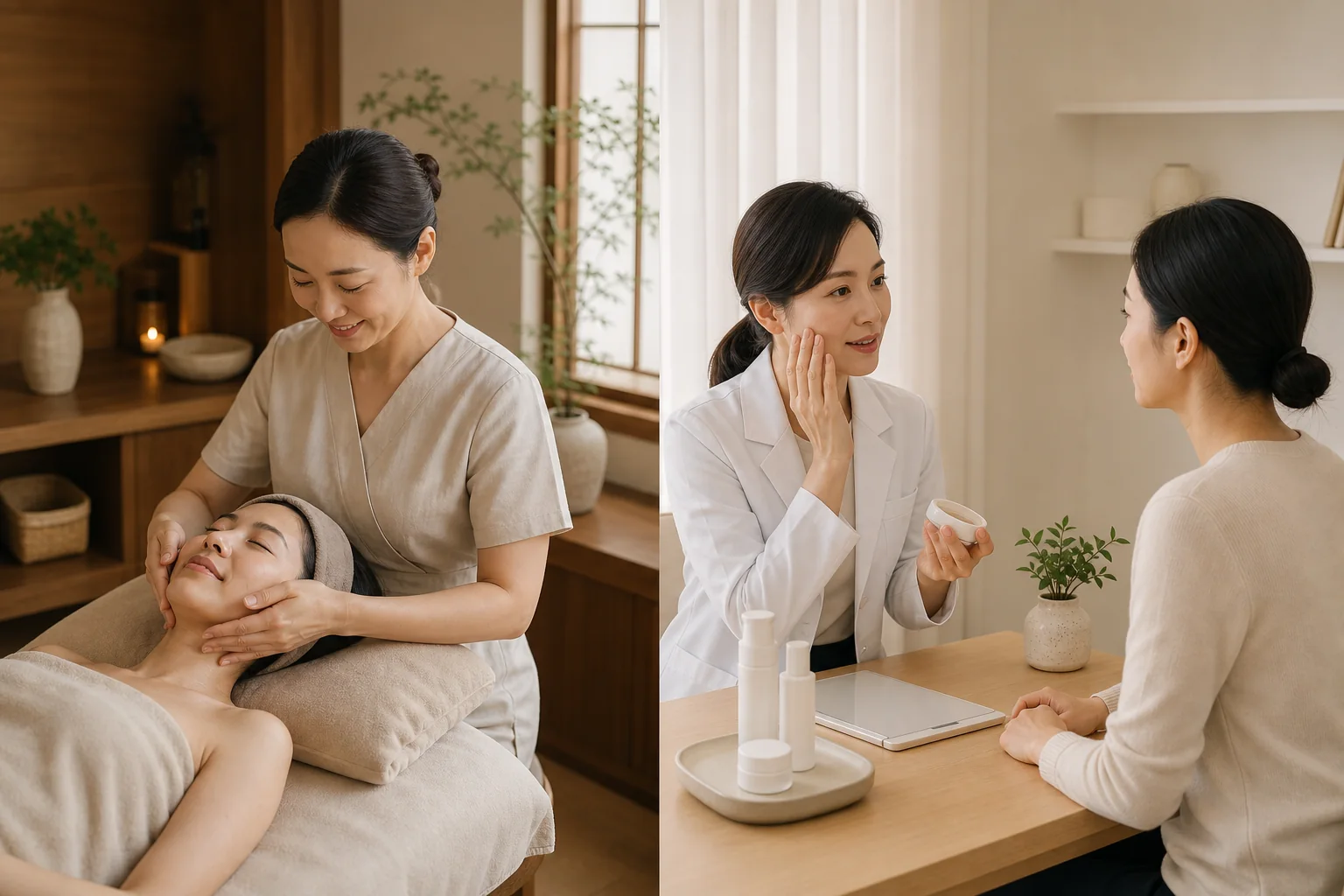
This guide draws that line clearly, walks through what a classic Korean facial actually includes step by step, covers popular add-ons like aqua peel, gives directional prices, and helps you route your concern to the right place. It's general information — anything medical, and whether a treatment suits you, is confirmed by a clinic and its doctor.
Section 01
The two worlds: 관리실 vs dermatology clinic
This is the distinction to get straight before anything else, because it decides what's even possible in the room. An esthetician-run skincare shop — 관리실, often labeled "esthetic" or "skin care" — is a non-medical business. Its job is care and maintenance of healthy skin: cleansing, hydration, relaxation, and comfort. A dermatology clinic (피부과 의원) is a medical facility with a licensed doctor, and it's the only one of the two that can legally perform medical procedures.
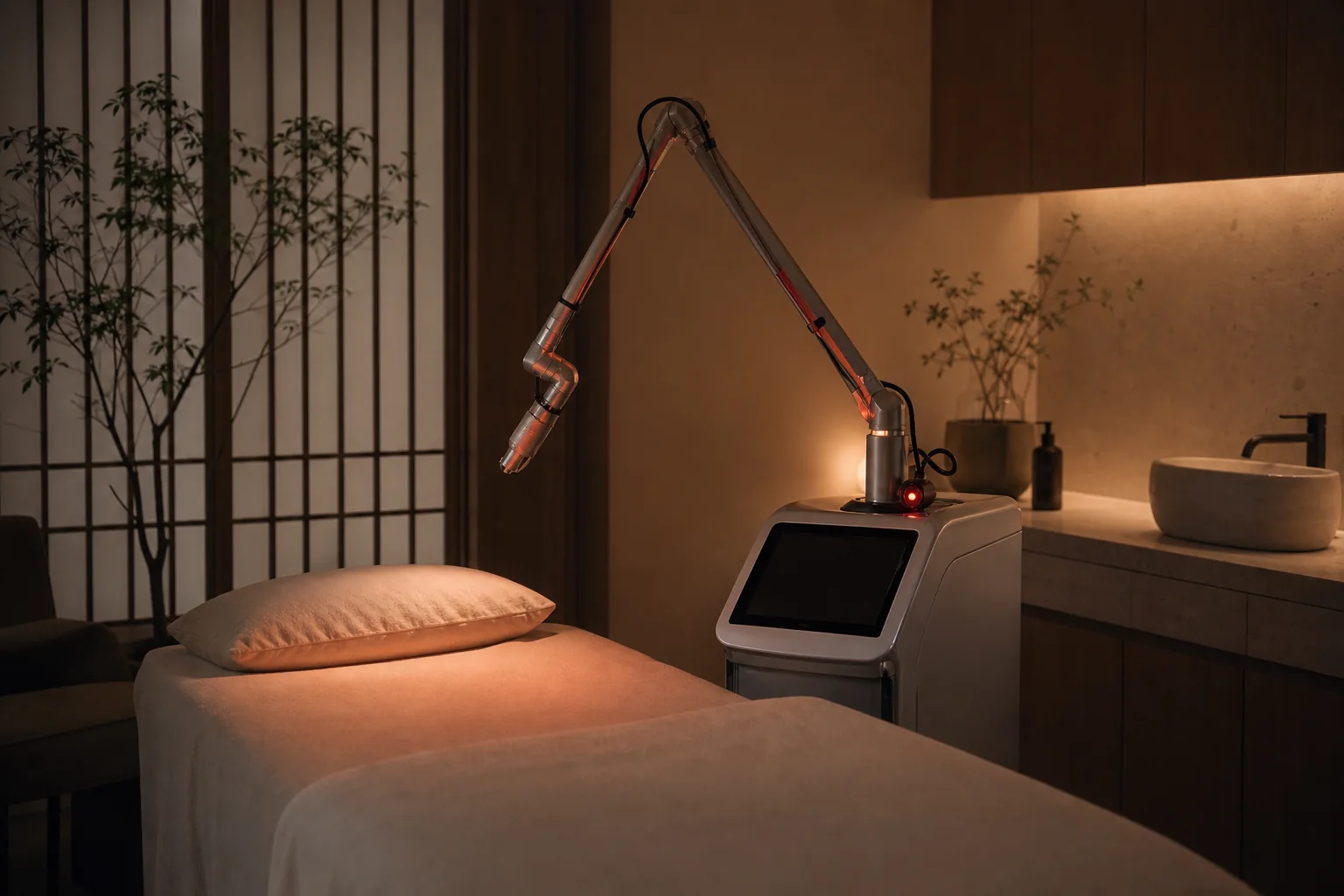
The practical rule is about what touches or enters the skin. Non-medical care stays at the surface. Medical acts — injections (skin boosters, Botox, filler), medical lasers, prescription treatments, and medical microneedling (MTS) that's done as a medical procedure — are the clinic's territory, performed or supervised by a doctor. A relaxing hydrating facial and a laser toning course are not two versions of the same thing; they live in different worlds with different rules.
| Skincare shop (관리실 / esthetic) | Dermatology clinic (피부과 의원) | |
|---|---|---|
| Nature | Non-medical care business | Medical facility with a licensed doctor |
| Focus | Cleansing, hydration, relaxation, maintenance | Diagnosis and medical treatment of the skin |
| Typical menu | Facials, extraction, massage, hydrating/modeling masks | Lasers, injections/boosters, prescription care, medical MTS |
| Who performs it | Estheticians | A doctor performs or supervises medical procedures |
| Price feel | Typically modest, session-based (~$40–150) | Higher and more variable by treatment |
General distinction, not legal advice. The line is that medical acts — anything breaking the skin as a medical procedure, injections, and medical lasers — belong in a clinic; a doctor confirms what's suitable for you.
Section 02
What a Korean facial actually includes
A classic Korean facial — the skincare-shop kind — is methodical and calm rather than dramatic. The appeal is the thoroughness and the feeling of properly cared-for skin afterward, not a single overnight transformation. The exact steps vary by shop and menu, but the shape is recognizable.
| Step | What happens | Why it's there |
|---|---|---|
| Cleanse | Often a double cleanse to fully remove makeup and sunscreen | A clean base for everything that follows |
| Steam / soften | Warm steam or towels to soften the skin and open pores | Makes gentle extraction easier and more comfortable |
| Extraction | Manual clearing of blackheads and congestion | The step people most associate with a "deep clean" |
| Treat | Massage, hydrating serums, sometimes a mild acid or add-on | Circulation, hydration, and a smoother surface |
| Mask | A hydrating or rubber "modeling" mask, then moisturizer + SPF | Locks in hydration and leaves skin calm and dewy |
A common shape, not a fixed protocol — menus differ. This is surface-level, non-medical care; anything medical is a clinic's domain.
Section 03
Popular add-ons, like aqua peel
Beyond the classic facial, a few add-ons come up again and again, and "aqua peel" is the one visitors ask about most. Aqua peel (the name blends "aqua" and "peel") is a water-based treatment that exfoliates dead skin and vacuums out pore debris — a gentle, hydrating deep-clean often described as leaving skin fresh and smooth. You'll find it on menus in both worlds, which is exactly why the two-worlds point matters: the core procedure is similar, but the setting, the price, the pre-treatment prep, and the surrounding care differ between a skincare shop and a clinic.
Other common surface add-ons include hydrating "물광"-style care (as pampering, not the injectable version — that's a clinic treatment), gentle enzyme or mild acid exfoliation, and LED or soothing masks. Keep the boundary in mind: if an "add-on" involves needles, a medical-grade laser, or medical microneedling, that's a medical procedure and belongs in a clinic with a doctor. When a treatment name shows up in both a spa menu and a clinic menu, ask what's actually being done and by whom.
Section 04
Prices, honestly
Price is one of the clearest ways the two worlds separate, though every figure here is directional and not a quote. A facial at an esthetician-run skincare shop is typically the more affordable option — a session-based, maintenance-priced treatment, often roughly $40–150 per session, with a basic aqua peel toward the lower end and a bundled full facial toward the upper end — and packages of several sessions are common. A comparable-sounding treatment at a dermatology clinic generally costs more and varies far more widely, because you're paying for a medical setting, a doctor's oversight, and often a different depth of treatment.
The trap is comparing by name alone. "Aqua peel" at a skincare shop and "aqua peel" at a clinic can carry different prices for a reason — different setting, prep, and aftercare — so compare what's actually included rather than the label. For anything medical, ask for an itemized quote and let the clinic confirm the real price after a consultation; first-visit promotions can look very cheap, so check what the price actually covers. Our guides on how Korean clinic pricing really works and the hidden costs to watch for go deeper.
Section 05
Which one do you need?
Route by your goal, not by the prettiest brochure. If you want relaxation, a thorough cleanse, hydration, and general upkeep for healthy skin, an esthetician-run skincare shop is the natural fit — it's what they do well, at a comfortable price. If your goal touches a skin concern that needs medical assessment or treatment — persistent acne, pigmentation and melasma, textured scarring, firmness and aging, or anything you'd want a diagnosis for — that's a dermatology clinic, where a doctor confirms what's suitable.
A simple test: if you're describing a problem you want fixed rather than skin you want maintained, start with a clinic. Many visitors do both on a trip — a relaxing facial for glow, and a clinic consultation for a specific concern — and there's no conflict in that. When you head to the clinic side, our guides on choosing a skin clinic and comparing Korea's popular treatments help you go in informed, and a doctor confirms the plan and price.
Frequently asked
Frequently asked
What's the difference between a Korean facial and a dermatology treatment?
They happen in two different kinds of place. A Korean facial usually means an esthetician-run skincare shop (관리실) — a non-medical setting focused on cleansing, hydration, relaxation, and maintenance of healthy skin. A dermatology treatment happens at a medical clinic (피부과 의원) with a licensed doctor and can go beyond the surface: lasers, injections, prescription care, and medical microneedling. Anything that breaks the skin as a medical act belongs in the clinic, where a doctor confirms what suits you.
What does a Korean facial include?
A classic Korean facial at a skincare shop is a methodical, relaxing routine rather than a single dramatic result. It typically runs through a thorough (often double) cleanse, warm steam to soften the skin, manual extraction of blackheads and congestion, a massage with hydrating serums, and a hydrating or rubber "modeling" mask, finishing with moisturizer and sun protection. The exact steps vary by shop, and it's surface-level, non-medical care.
What is an aqua peel facial?
Aqua peel is a water-based treatment that gently exfoliates dead skin and vacuums debris out of pores — a hydrating deep-clean that leaves skin feeling fresh and smooth. It's a popular add-on offered at both skincare shops and dermatology clinics. The core procedure is similar in both, but the setting, price, prep, and surrounding care differ, so it's worth asking exactly what's being done and where.
Is a Korean facial done at a dermatologist or a spa?
It can be either, and that's the key thing to understand. Relaxing, hydrating facials are typically done at esthetician-run skincare shops (관리실), which are non-medical. Dermatology clinics offer treatments too, but those lean medical — lasers, injections, and prescription care under a doctor. If your goal is relaxation and maintenance, a skincare shop fits; if it's a specific skin concern needing assessment, start with a clinic.
How much does a Korean facial cost?
Directionally, a facial at an esthetician-run skincare shop is typically the more affordable option — a modest, session-based price (roughly $40–150 / session), often sold in packages — while a comparable treatment at a dermatology clinic generally costs more and varies far more widely because of the medical setting and doctor oversight. These are reference points, not quotes; for anything medical, the clinic confirms your actual price after a consultation, so ask for an itemized quote and check what it covers.
Can an esthetician in Korea do injections or laser treatments?
No — those are medical procedures. Esthetician-run skincare shops legally provide surface, non-medical care: cleansing, steaming, extraction, massage, and hydrating or modeling masks. Injections (skin boosters, Botox, filler), medical lasers, and medical microneedling (MTS) done as a medical act must be performed or supervised by a doctor at a clinic. If a non-medical shop offers something that breaks the skin medically, treat that as a red flag.
Related guides
Related guides
Related treatments
This guide is general information to help you prepare — it is not medical advice. Suitability, the final treatment plan, and pricing are confirmed only by a licensed clinic.
Before you book, verify the clinic yourself
This is general information, not a recommendation of any clinic. Check any clinic on Korea's official foreign-patient registry and use our verification checklist.