
Independent field guide · Start here
English-speaking dermatology in Seoul — 101 clinics, what to confirm
101 of 1,253 Seoul registry clinics list English (KHIDI 2026-06-25). Listing ≠ today's consult. Confirm the doctor, deposit, and card by phone.
9 min read · By Glow in Seoul editorial · Updated August 27, 2026
Start with the essentials
Start with the number: 101 of the 1,253 Seoul skin and cosmetic clinics on Korea's official foreign-patient registry list English in their record (KHIDI snapshot 2026-06-25); 42 list Chinese and 33 list Japanese. That field is self-reported at registration, so read it as a shortlist, not a promise — it tells you the clinic set itself up for foreign patients, not that today's consultation runs in English.
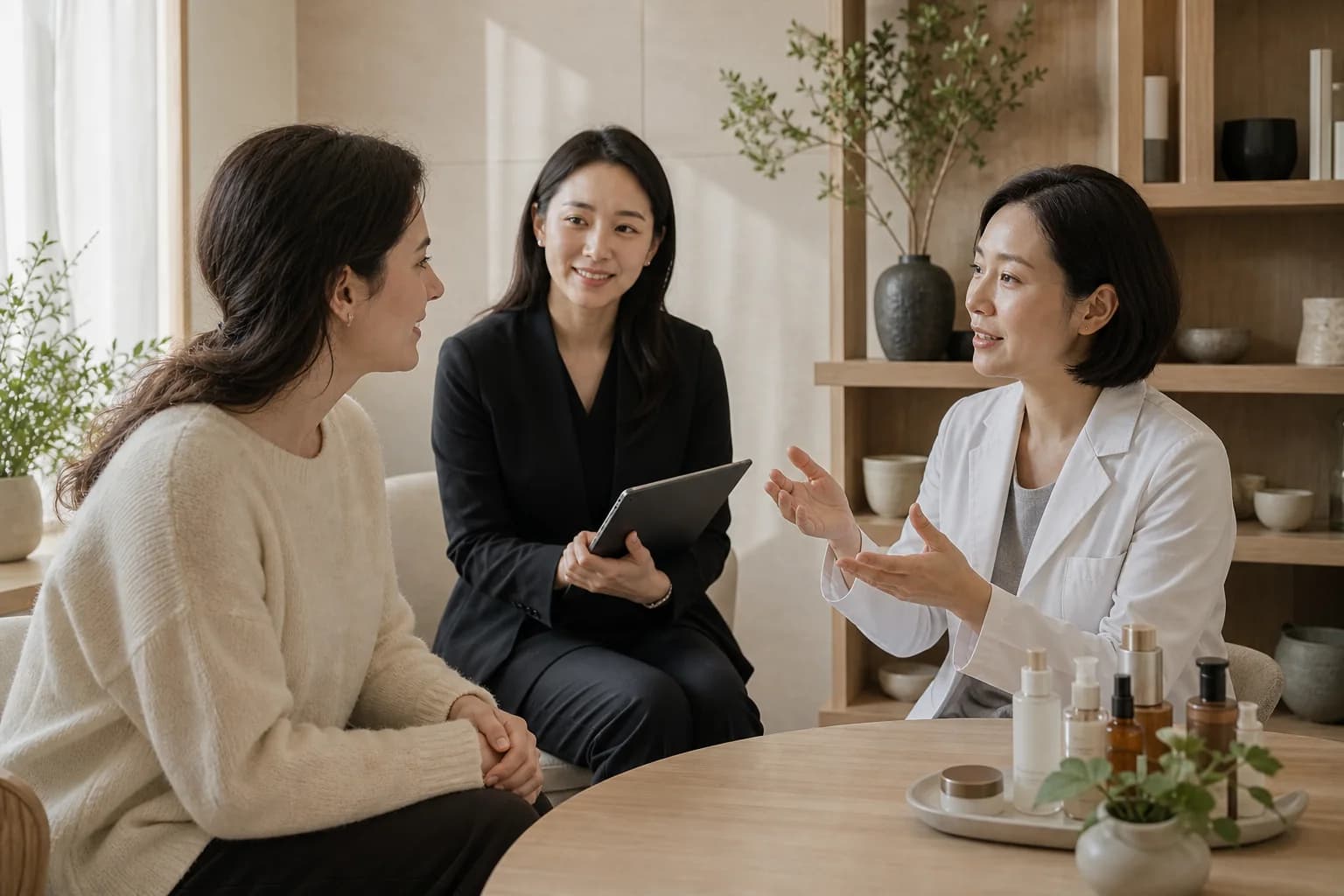
So the reliable sequence is: shortlist from the registry, then confirm two things by phone or email before you book — whether the doctor's consultation itself (not just the booking) is in English, and who explains aftercare, in what language. You can start that shortlist here: we publish all 101 clinics that list English, broken down by district, alongside the Chinese and Japanese lists. If a clinic you like isn't fully English-equipped, the free 1330 helpline can interpret by phone, 24/7 for English, from inside a clinic.
If a Korean-speaking friend is calling for you — deposit, foreign cards, a dedicated coordinator — use the guide written for people booking on a friend's behalf. This page is the registry shortlist and how to confirm that the doctor's consult, not just reception, runs in English.
This guide covers what English support at a Seoul skin clinic actually looks like, the concrete signals that a clinic is set up for foreign patients, how to verify official registration, the interpretation options if the language gap is wide, and a short list of English phrases worth having ready. It's general information — a doctor confirms what's suitable for your skin, and any treatment plan and price are confirmed by the clinic.
Section 01
How much English you'll actually get
The honest picture is uneven, and it helps to expect that. In the clinic-dense districts foreign patients gravitate to — Gangnam, Apgujeong, Myeongdong — a large share of consultations can be handled in English, either directly by a doctor or through a coordinator, because those clinics see international patients routinely. Reception staff at foreigner-facing clinics often speak workable English, and the paperwork is frequently available in English too.
Where it gets thinner is predictable: smaller neighborhood clinics that mainly serve locals, the hands-on treatment room (the person performing a laser or injection may speak less English than the consulting doctor), and the nuance of aftercare instructions, where precision matters most. None of this is a reason to avoid Korean clinics — it's a reason to confirm the specific clinic's setup in advance and to line up an interpreter option for anything detailed. If a Korean friend is doing the calling for you, our guide for Korean speakers helping a foreign friend covers the same checks from their side, and our guide to Korea's support system for foreign patients covers the wider safety net.
Section 02
Signals a clinic is set up for English speakers
Rather than trusting a clinic's own claim that it's "foreigner friendly," look for signals you can check yourself. The strongest is official registration (covered next); the rest are practical tells that a clinic actually handles international patients day to day.
| Signal | What it tells you | How to check |
|---|---|---|
| English booking page or form | The clinic expects and processes foreign inquiries | Look for a real English site or booking flow, not just a translated homepage |
| Named foreign-patient coordinator | There's a person whose job is your language and logistics | Ask directly: "Is there an English-speaking coordinator for my visit?" |
| Official registration to treat foreign patients | It's legally cleared and carries required malpractice insurance | Verify on medicalkorea.or.kr (see below) |
| Written English consultation and consent | Aftercare and consent won't get lost in translation | Ask if consultation notes and aftercare come in English |
| Clear, itemized quote in English | Pricing is transparent, not improvised on the day | Request an itemized quote before you commit |
Signals, not a ranking — we don't rank clinics. A clinic can be excellent without all of these, but the more it can show, the smoother an English-language visit tends to go.
Section 03
Verify official registration (the step most people skip)
This is the single most useful check, and it's free. In Korea, only medical institutions officially registered with the government as foreign-patient-attracting institutions may legally treat international patients — and registered institutions are required to carry medical malpractice liability insurance. That registration is both a legal line and a quiet quality filter, because it means the clinic has formally set itself up to handle foreign patients.
You can confirm any clinic yourself, in a few minutes — and if you want the wider context first, our 2026 report on Seoul's registered foreign-patient clinics sets out how many clinics hold that registration, where they are, and what the 101 English entries do and don't prove.
| Step | What to do |
|---|---|
| 1. Open the official lookup | Go to medicalkorea.or.kr (run by KHIDI under the Ministry of Health & Welfare) and find the registered-institutions search |
| 2. Search the clinic | Search by the clinic's name, location, or specialty to see if it's listed |
| 3. Ask for the certificate | If in doubt, ask the clinic for its registration certificate for foreign-patient attraction |
| 4. Treat absence as a flag | A clinic not listed and unable to show registration isn't legally cleared to treat foreign patients — a reason to pause |
General guidance, not legal advice. The lookup is the authoritative source; our directory is built from the same official registration data to save you the first search.
Section 04
Interpretation options if the language gap is wide
If a clinic you love isn't fully English-equipped, or you just want detail-perfect communication for consent and aftercare, you have real options — you don't have to rely on guesswork or a translation app for the important parts.
The one most visitors don't know about is national and free: the 1330 Korea Travel Helpline, run by the Korea Tourism Organization. It operates 24/7 (English, Japanese, and Chinese around the clock; some other languages during daytime hours), and its staff can interpret for you over the phone — including at a hospital or clinic — by relaying between you and the staff. You dial 1330 inside Korea (or +82-2-1330 from abroad), and you pay only normal call charges. It's a genuine safety net for a consultation where the language gap turns out wider than expected.
Beyond that, many foreigner-focused clinics provide their own in-house interpreters or coordinators for major languages — worth asking about when you book. Private medical concierge and interpretation services also exist as a paid option for people who want a dedicated person for the whole visit; treat that as a convenience choice, not a necessity, and know that a coordinator is there to help you communicate, not to replace the doctor's own confirmation of what suits you.
| Option | Cost | Best for |
|---|---|---|
| 1330 Travel Helpline (phone interpreting) | Free beyond call charges | On-the-spot interpreting when a clinic's English runs short |
| Clinic's own coordinator / interpreter | Usually included | Foreigner-facing clinics; confirm when booking |
| Private medical concierge / interpreter | Paid | A dedicated person for the whole visit, if you want it |
Neutral options, not endorsements. Availability and languages vary; confirm details directly.
Section 05
Phrases and questions to bring to your consultation
You don't need Korean, but a handful of clear questions makes any consultation go better — and asking them signals you'll be an informed patient. Keep them simple and direct; a good clinic welcomes them.
On logistics and language: "Is there an English-speaking doctor or coordinator?" "Can I get the consultation notes and aftercare instructions in English?" On the treatment itself: "What exactly are you recommending, and what is it for?" "What are the realistic downsides and the downtime?" "Is this suitable for my skin — and what happens if it isn't right for me?" On money, before you agree to anything: "Can I see an itemized price in writing?" "Does that include numbing, aftercare, and any repeat sessions?" And a useful catch-all: "What would you do differently for a visitor who flies home in a few days?" Our guides on your first clinic visit and how Korean clinic pricing really works go deeper on both.
Section 06
Using our Seoul clinics directory
To take the first search off your plate, our clinics directory lists 1,253 Seoul skin clinics (KHIDI snapshot 2026-06-25), built from official government registration data rather than a curated favorites list — which is deliberate, because we don't rank clinics or steer you to one. You can filter by district to match where you're staying and by specialty to separate dermatology from plastic surgery, and every entry shows the languages the registry records for that clinic (our guide to Seoul's clinic neighborhoods explains how the districts differ).
Use the directory to build a shortlist, then apply the checks in this guide: confirm official registration on medicalkorea.or.kr, ask about an English coordinator and written aftercare, and get an itemized quote before you commit. The directory narrows the field; the consultation — where a doctor confirms what actually suits your skin — is still where the real decision happens.
Frequently asked
Frequently asked
Are there English-speaking dermatologists in Seoul?
Yes, and they're common in the clinic-dense districts foreign patients use most — Gangnam, Apgujeong, and Myeongdong — where many clinics handle consultations in English directly or through a coordinator. English is patchier at smaller neighborhood clinics and can thin out in the treatment room, so the reliable approach is to confirm a specific clinic's foreign-patient handling before you book rather than assuming. In our clinics directory — built from the official registry, KHIDI snapshot 2026-06-25 — 101 of the 1,253 Seoul entries list English in their official record, which is where a shortlist starts.
How do I find a skin clinic in Seoul that treats foreigners?
Start with checkable signals: an English booking page, a named foreign-patient coordinator, and — most importantly — official registration to treat international patients, which you can verify free on medicalkorea.or.kr. Our Seoul clinics directory is built from that official registration data (1,253 Seoul clinics, KHIDI snapshot 2026-06-25); filter by district and specialty, and read the languages each entry records, to build a shortlist. Then confirm details with each clinic — English consultation, deposit and payment method — and get an itemized quote before committing.
How can I check if a Seoul clinic is officially allowed to treat foreign patients?
Use the public lookup at medicalkorea.or.kr, run by KHIDI under Korea's Ministry of Health & Welfare. Only medical institutions registered as foreign-patient-attracting institutions may legally treat international patients, and they're required to carry medical malpractice insurance. Search the clinic by name, location, or specialty; if it isn't listed and can't show a registration certificate, it isn't legally cleared to treat foreign patients — a reason to pause.
What is the 1330 helpline and can it help at a clinic?
1330 is the Korea Travel Helpline, run by the Korea Tourism Organization. It operates 24/7 (English, Japanese, and Chinese around the clock; some other languages during daytime hours) and its staff can interpret for you by phone — including at a hospital or clinic — by relaying between you and the staff. You dial 1330 in Korea or +82-2-1330 from abroad, and pay only normal call charges. It's a free safety net when a clinic's English turns out thinner than expected.
Do I need to speak Korean to get a skin treatment in Seoul?
No. Many foreigner-facing clinics handle consultations in English or provide a coordinator, and the free 1330 helpline can interpret by phone if the gap is wide. For anything detailed — consent, aftercare, exactly what a treatment involves — it's worth lining up an interpreter option in advance and asking for written English instructions. A translation app covers small talk, but don't rely on it alone for medical detail.
Should I use a medical concierge or interpreter service in Seoul?
It's optional, not required. Many clinics already provide their own coordinator or interpreter, and the free 1330 helpline covers on-the-spot phone interpreting. A paid private concierge or interpreter can be worth it if you want one dedicated person managing the whole visit, but treat it as a convenience rather than a necessity — and remember a coordinator helps you communicate, while the doctor is still the one who confirms what suits your skin.
Related guides
Related guides

Related treatments
References
Notes & sources
This guide is general information to help you prepare — it is not medical advice. Suitability, the final treatment plan, and pricing are confirmed only by a licensed clinic.
Planning a Seoul clinic visit?
Build a Visit Plan around your dates — trip fit, directional budget, and a doctor-ready brief.